

API testing is the practice of checking an API directly, without a user interface, to confirm that it returns the right data, enforces the right rules, stays fast under load and rejects requests it should reject. Because almost every modern product (web app, mobile app, partner integration or AI agent) talks to its backend through APIs, testing at this layer catches most business logic and security defects earlier and more cheaply than UI testing does. This guide covers the main categories and types of API tests, the tools teams actually use in 2026, and a practical way to build an API test suite that runs on every pull request.
Key takeaways
- API testing exercises endpoints directly over HTTP or gRPC, so tests are faster, more stable and easier to automate than end-to-end tests driven through a browser.
- A complete strategy covers functionality, contracts, reliability, performance and security, because a correct response that takes four seconds or leaks another user’s data is still a failure.
- Schema-first development with OpenAPI lets you generate tests, mocks and contract checks from one specification instead of maintaining them by hand.
- Authorization bugs, where one user can read or change another user’s records, are among the most common serious API flaws and need dedicated negative tests.
- Run fast functional and contract tests on every pull request, and schedule heavier load and security scans nightly or before each release.
What API Testing Is and Why It Matters
An API is the contract between two pieces of software: a client sends a request with a method, path, headers and body, and the server returns a status code and a response. API testing sends those requests on purpose, with known inputs, and checks every part of the response against what the contract promises.
Where it sits in the testing pyramid
Unit tests check individual functions. End-to-end tests drive a real browser or device through complete user journeys. API tests sit in the middle: they exercise real routing, validation, database queries and authorization logic, but skip the rendering layer. That makes them the best value layer for most backend teams. A suite of 500 API tests can often finish in a few minutes, while the same coverage through a browser could take far longer and break whenever a button moves.
Why it matters more every year
Products now have more API consumers than ever. A single backend may serve a React web app, an iOS app, an Android app, a partner integration, a webhook consumer and, increasingly, AI agents calling tools through function calling or the Model Context Protocol. Each consumer depends on the same contract. When a field is renamed or a status code changes, the UI team may notice, but the partner integration fails silently at 2 a.m. API tests are the safety net that protects every consumer at once. If you are weighing how agents change integration patterns, our MCP vs API comparison covers that shift.
What a good API test checks
- Status code: 200, 201, 400, 401, 403, 404, 409 or 422 as the contract specifies.
- Response schema: required fields present, correct types, no unexpected nulls.
- Business values: totals, statuses and calculated fields are correct for the given input.
- Headers: content type, caching, rate-limit headers and CORS behavior.
- Side effects: the database row was created, the event was published, the email job was queued.
- Timing: the response arrived within the agreed latency budget.
The Five Core Test Categories
The original categories for API testing still hold: functionality, reliability, latency, performance and security. Each answers a different question about the API, and a gap in any one of them can cause a production incident.
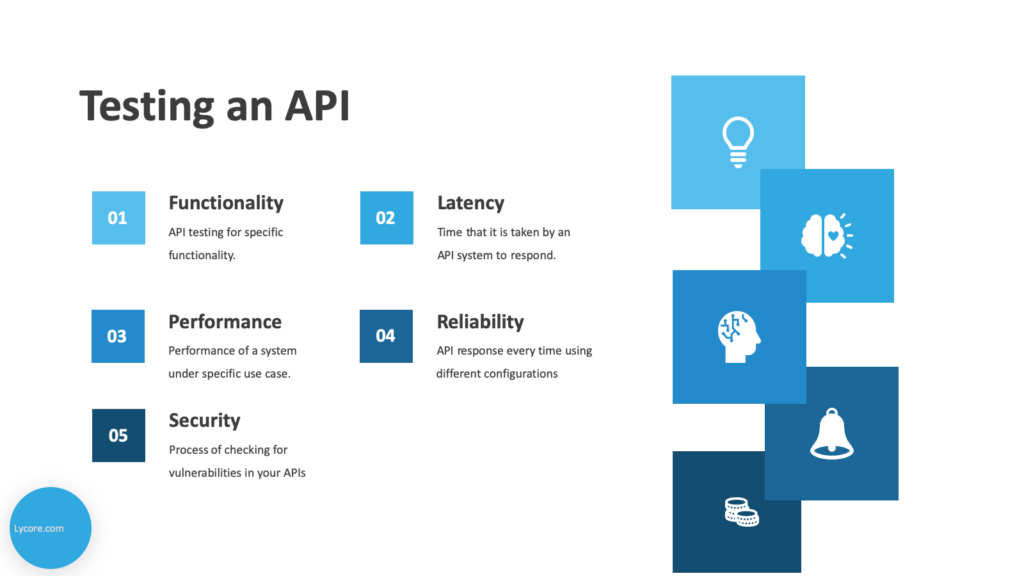
Functionality
Does the endpoint do what it is supposed to do? Functional tests cover the happy path (valid input, expected output) and, just as importantly, the edge and error paths: missing fields, wrong types, values at the boundary of allowed ranges, duplicate submissions and requests for records that do not exist. A well-tested endpoint returns a clear 4xx error with a useful message instead of a 500.
Reliability
Does the API produce consistent results over time and recover cleanly from failures? Reliability tests repeat the same calls many times, check idempotency (sending the same payment request twice with the same idempotency key should not charge twice), and verify behavior when a dependency such as a database replica or third-party service is slow or down.
Latency
How long does a single request take? Latency is usually measured from the moment the server receives a request to the moment the response is complete. Look at percentiles rather than averages: a p50 of 80 ms means little if p99 is 3 seconds, because that slow tail is what real users notice.
Performance and load
How does the API behave when many clients call it at once? Load tests apply expected traffic, stress tests push past it to find the breaking point, and soak tests hold steady load for hours to expose memory leaks and connection pool exhaustion. The classic lesson came in February 2022, when Coinbase’s Super Bowl QR-code ad drove so much traffic that its app briefly struggled to keep up. Marketing launches are exactly when load testing pays for itself.
Security
Does the API reject what it should reject? That includes unauthenticated calls, expired tokens, access to another tenant’s data, oversized payloads, injection attempts and excessive request rates. Security deserves its own section later in this guide.
Test Types You Should Know
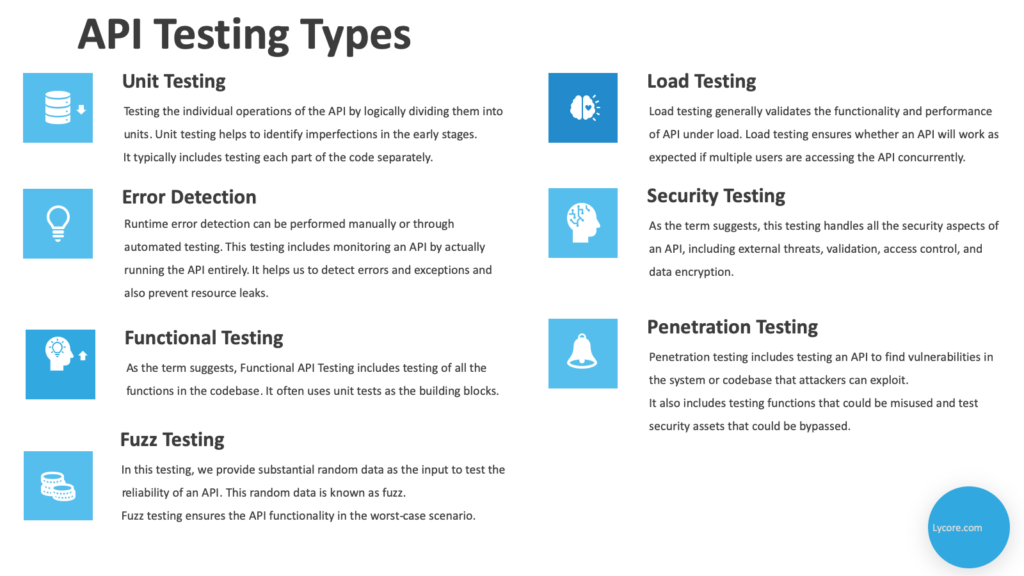
Categories describe what you are checking. Test types describe how and at what scope you check it. Most mature teams use several of these together.
Unit and component tests
These test a single handler or service in isolation, usually with the database and external services mocked or run in a container. In Node.js, Supertest with Jest or Vitest is a common pattern; in Python, pytest with the FastAPI or Django test client; in Java, Spring’s MockMvc or WebTestClient. They run in seconds and should cover most validation and business rules.
Integration tests
Integration tests run the API against real dependencies: a real PostgreSQL instance, a real Redis, a real message queue. Testcontainers (available for Java, Go, .NET, Node.js and Python) makes this practical by starting throwaway containers for each test run, so tests do not depend on a shared staging database that someone else might be changing.
Contract tests
Contract tests check that the provider and its consumers agree on the shape of requests and responses. Consumer-driven contract testing with Pact lets each consumer publish the interactions it relies on, and the provider’s pipeline verifies them before release. The alternative is schema-based contract testing, where the OpenAPI specification is the contract and tools validate real responses against it.
End-to-end API flows
These chain several calls into a realistic scenario: create an account, log in, add items to a cart, check out, verify the order status. They catch problems that only appear when state carries across requests.
Load, fuzz and security tests
Load tests use tools such as k6, Gatling, JMeter or Locust. Fuzz tests generate large numbers of unexpected inputs; Schemathesis does this from an OpenAPI or GraphQL schema and is effective at finding unhandled 500 errors. Security scans use tools such as ZAP or Burp Suite, combined with targeted manual tests for authorization logic.
| Test type | Main question | Typical tools | When to run |
|---|---|---|---|
| Unit or component | Does this handler apply the rules correctly? | Jest or Vitest with Supertest, pytest, JUnit | Every commit |
| Integration | Does it work with real dependencies? | Testcontainers, pytest, REST Assured | Every pull request |
| Contract | Do provider and consumers still agree? | Pact, OpenAPI validators | Every pull request |
| End-to-end flow | Does a full scenario work across calls? | Postman with Newman, Karate, Playwright | Every merge to main |
| Load and stress | Does it hold up under traffic? | k6, Gatling, JMeter, Locust | Nightly and before launches |
| Fuzz and security | Does it fail safely on bad or hostile input? | Schemathesis, ZAP, Burp Suite | Nightly and before releases |
API Testing Tools Compared
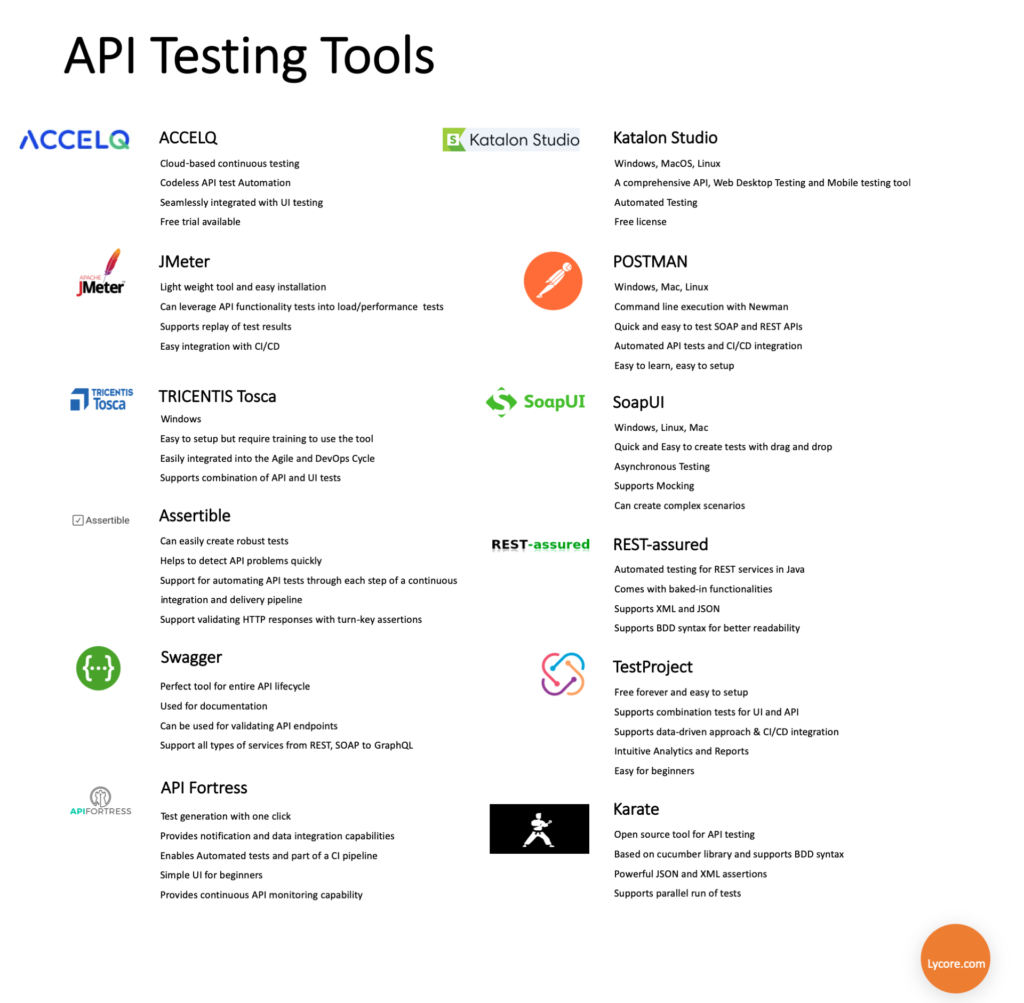
There is no single best tool. Most teams pair an interactive client for exploration with code-based tests that live in the same repository as the API.
Interactive clients
Postman remains the most widely recognized API client, with collections, environments, scripted assertions and the Newman command-line runner for CI. Insomnia, maintained by Kong, offers a similar workflow. Bruno has gained popularity because it stores collections as plain text files in your Git repository, which makes reviews and versioning straightforward. Hoppscotch is a lightweight open-source option that runs in the browser. These tools are excellent for exploring an API and writing first tests, but large suites are usually easier to maintain in code.
Code-based frameworks
Writing API tests in the same language as your service keeps them close to the code and lets developers refactor both together. REST Assured is the standard choice in Java. Karate uses a readable Gherkin-like syntax and supports HTTP, GraphQL and simple performance testing in one tool. JavaScript and TypeScript teams often use Playwright’s request API, which pairs well if Playwright already handles UI tests. Python teams typically use pytest with httpx or requests.
Mocking and virtualization
When a dependency is unavailable, expensive or rate limited, mock it. WireMock and Mockoon simulate HTTP services, and Prism can serve a mock directly from an OpenAPI file, which lets frontend and mobile teams start building before the backend exists.
Choosing a stack
Start with what fits your language and CI: a code-based framework for most tests, Pact or schema validation for contracts, k6 for load and ZAP for automated security scanning. Add an interactive client for exploration and for sharing examples with partners. Check current licensing and team-plan terms for commercial tools directly with each vendor, since these change often.
Building a Test Strategy That Scales
Tools matter less than a clear strategy. The goal is a suite that developers trust, that runs fast enough to use on every change, and that grows with the API instead of becoming a burden.
Start from the specification
Write or generate an OpenAPI 3.1 document for every REST API and treat it as the source of truth. Lint it with Spectral to enforce naming, pagination and error-format conventions. From that one file you can generate client SDKs, mock servers, documentation and schema-validation tests. Teams building with frameworks such as FastAPI or Django REST Framework can generate the spec from code; our guide to building Django REST APIs walks through that setup.
Manage test data deliberately
Flaky API tests are almost always data problems. Each test should create the data it needs, use unique identifiers so parallel runs do not collide, and clean up after itself, or run against a fresh database container. Avoid tests that depend on a specific record existing in a shared staging environment.
Wire it into CI/CD
- On every pull request: unit, integration, contract and schema tests, with a target of under ten minutes.
- On merge to main: end-to-end API flows against a deployed preview or staging environment.
- Nightly: load tests at expected peak, fuzzing with Schemathesis and an automated ZAP scan.
- Before major launches: stress and soak tests sized to the marketing plan, not last month’s traffic.
Measure what matters
Track endpoint coverage (which operations in the spec have at least one passing and one failing test), flaky test rate, suite duration and escaped defects that reached production. Code coverage alone can look healthy while whole endpoints have no negative tests.
API Security Testing in Practice
Security is the category teams most often leave to a yearly penetration test. That is too infrequent for APIs that change every week. The OWASP API Security Top 10 is a useful checklist, and broken object level authorization sits at the top of it for good reason.
Authorization tests every API needs
Broken object level authorization happens when an endpoint such as GET /invoices/123 checks that the caller is logged in but not that invoice 123 belongs to them. Automated scanners rarely find this, because they do not understand your data ownership rules. Write explicit tests: create two users in two tenants, then confirm that user A receives 403 or 404 for every one of user B’s resources, for every method. Do the same for function-level authorization, confirming that a regular user cannot call admin endpoints.
Authentication and token handling
Test expired tokens, tokens signed with the wrong key, tokens with a modified payload and tokens for deleted users. For OAuth 2.0 and OpenID Connect flows, confirm that scopes are enforced per endpoint and that refresh tokens are revoked on logout or password change.
Input, rate limits and data exposure
- Send oversized payloads, deeply nested JSON and unexpected content types, and confirm the API rejects them cleanly.
- Check that rate limits apply per user and per IP, and that limits return 429 with a Retry-After header.
- Compare response bodies with what the client actually needs; APIs often leak internal IDs, email addresses or password hashes through over-broad serializers.
- Confirm error responses do not include stack traces or SQL fragments in production.
Compliance context
If your API handles payment card data, consumer financial data, student records or personal data covered by state privacy laws such as CCPA/CPRA, security testing is also part of showing that you maintain reasonable safeguards. Ask counsel which frameworks apply to your product, and keep test reports as evidence.
Common Mistakes and How to Avoid Them
Most API test suites fail slowly: they start strong, then become slow, flaky and ignored. These are the patterns that cause it.
Testing only the happy path
A suite that only sends valid requests proves very little. For every endpoint, aim for at least one test per expected error: validation failure, missing authentication, wrong role, missing record and conflict. Error paths are where most production bugs and security issues hide.
Asserting too little or too much
Checking only for a 200 status misses broken payloads. Snapshot-comparing an entire response breaks every time a timestamp or new optional field changes. A better approach is to validate the response against the schema, then assert specifically on the fields that matter for that test.
Depending on shared environments
Tests that run against a shared staging database fail whenever someone else changes data there, and developers quickly learn to rerun failed jobs instead of investigating. Use containers or isolated test tenants so failures mean something.
Ignoring third-party APIs
Your product also depends on APIs you do not own: payments, email, maps, identity and AI model providers. Mock them in fast tests, but also run a small set of scheduled checks against their sandboxes so you find out when a provider changes behavior before your customers do. Our API development and integration services page describes how we approach these integrations.
Treating performance as a launch task
Load testing once before launch, then never again, means regressions creep in unnoticed. A nightly k6 run with fixed thresholds (for example, p95 under 300 ms and error rate under 1 percent at expected peak) catches slow queries and missing indexes while they are still easy to fix.
Pros and Cons of API Testing
Pros
- Tests run much faster than UI tests and give developers feedback within minutes.
- API tests are more stable because they do not depend on page layout or visual changes.
- One suite protects every consumer of the API, including mobile apps, partners and AI agents.
- Business logic and authorization defects are caught before they reach production.
- Specifications such as OpenAPI let you generate mocks, contracts and many tests automatically.
Cons
- API tests do not catch UI problems, accessibility issues or layout regressions, so some end-to-end testing is still needed.
- Good tests require deliberate test data management, which takes setup effort.
- Contract testing across many teams needs coordination and a shared broker or specification process.
- Load and security testing need realistic environments, which can add infrastructure cost.
- A large suite can become slow and flaky if it is not maintained like production code.
Frequently Asked Questions
What is the difference between API testing and UI testing?
UI testing drives the application the way a user does, through a browser or mobile device, clicking buttons and reading what appears on screen. API testing skips the interface and sends requests straight to the backend, checking status codes, response bodies, headers and side effects. API tests are faster, cheaper to maintain and better at covering business rules and error cases, because you can send any input directly without building a UI path to it. UI tests are still needed for layout, accessibility and complete user journeys. Most teams keep a large API suite and a smaller set of critical end-to-end UI tests on top of it.
Can API testing be fully automated?
Most of it can and should be. Functional, contract, schema, regression and load tests are well suited to automation and belong in your CI/CD pipeline. Automated security scanners and fuzzers also catch many issues. What automation does poorly is reasoning about business intent: whether a pricing rule makes sense, or whether one tenant could reach another tenant’s data through a chain of legitimate calls. That still needs a person who understands the domain, either through exploratory testing in a tool such as Postman or Bruno, or through periodic manual security review. A practical target is automated coverage for every endpoint plus scheduled human review of the riskiest flows.
How do you test GraphQL and gRPC APIs?
The principles are the same, but the tooling differs. GraphQL has a single endpoint, so tests focus on queries and mutations: validate responses against the schema, test authorization at the field and resolver level, and set query depth and complexity limits to prevent expensive nested queries. Schemathesis, Karate and Postman all support GraphQL. gRPC uses Protocol Buffers over HTTP/2, so you test with tools such as grpcurl, Postman’s gRPC support, or language-native clients generated from the .proto files. For both, contract checks become schema compatibility checks: tools such as buf can detect breaking changes in .proto files before they merge.
How many API tests are enough?
There is no fixed number, but there is a useful minimum. Every operation in your specification should have at least one positive test and one test for each expected error, including authentication and authorization failures. Every critical flow, such as signup, checkout or payment, should have an end-to-end API scenario. Every resource that belongs to a user or tenant should have cross-tenant access tests. Beyond that, add tests where bugs have occurred: each production defect should leave behind a regression test. Track endpoint coverage and escaped defects over time; if bugs keep reaching production in a specific area, that area needs more tests.
Conclusion
API testing is the most efficient way to keep a modern product reliable, because the API is the one layer every client depends on. Cover all five categories (functionality, reliability, latency, performance and security), use the right test types at the right stage of your pipeline, and build from an OpenAPI or schema specification so tests, mocks and contracts stay in sync. Put authorization tests near the top of your priority list, keep test data isolated, and run load and security checks on a schedule rather than once before launch. A suite built this way stays fast, trusted and useful as your API grows.
Building or hardening an API for your product? Talk to Lycore. We design, build and test APIs and the web and mobile apps that depend on them, with automated test suites wired into your CI/CD pipeline.

Open Banking APIs: A US Guide for Fintech Teams
[…] across syncs, joint accounts, and accounts that disappear after a bank migration. Our guide to API testing covers the broader […]