
AI for Ride Sharing and Ride Hailing
Every ride request is a real-time decision: which driver, at what price, by which route. AI improves those decisions with smarter matching, demand forecasts, explainable pricing, safety monitoring and dispatcher tools. We design and build these systems for ride-hailing, shuttle and local delivery platforms.
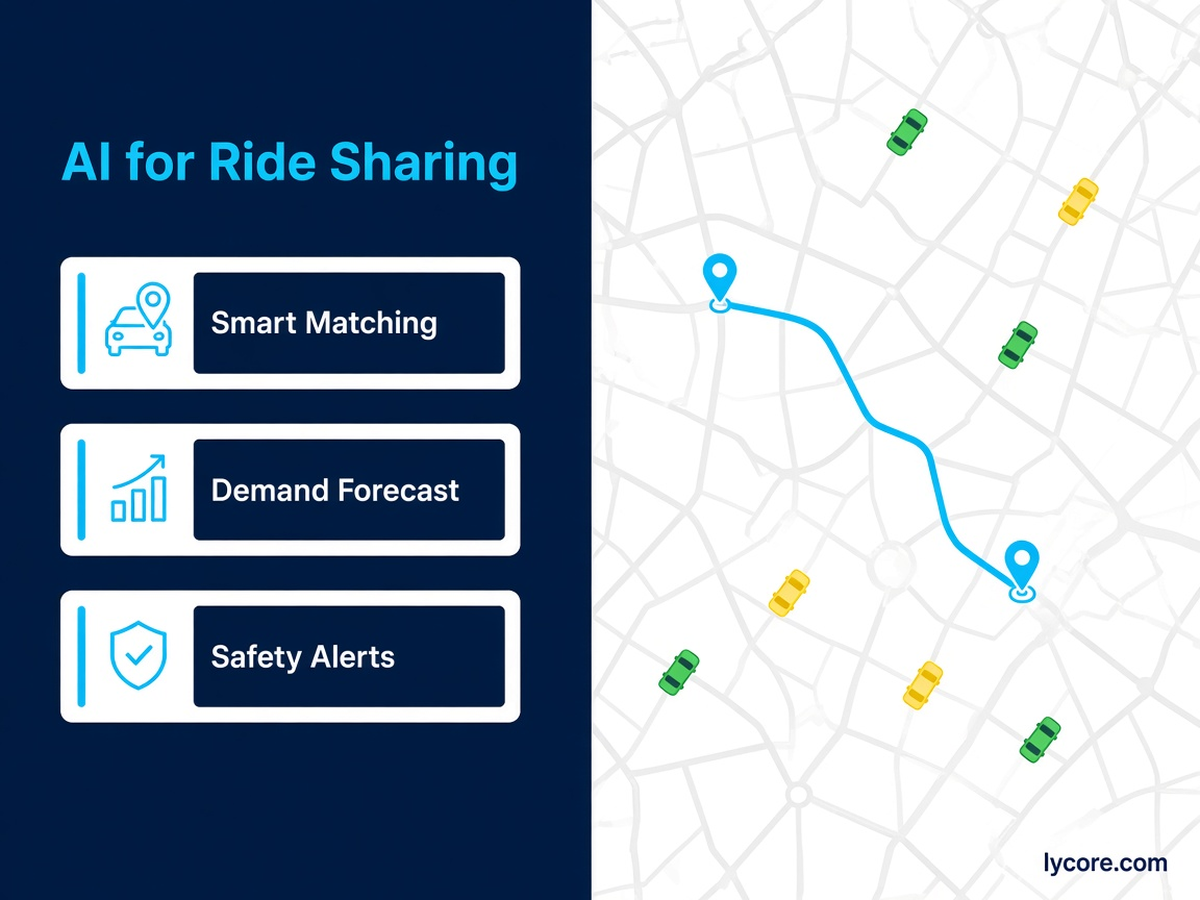
What does AI for ride sharing involve?
AI for ride sharing covers the models and tools behind a mobility platform: matching riders to drivers, forecasting demand by area and time, setting prices within clear rules, spotting safety issues during trips and helping operations teams act on live data. Good systems are fast, explainable and leave pricing policy and safety escalations to people.
Mobility platforms differ from other on-demand apps because supply and demand both move on a map. Drivers reposition, riders appear in clusters, and every trip changes where the next one can start. The platform, the driver and the rider also see different information, and pricing and operations are regulated in many cities. We build AI that respects those dynamics, using the trip, location and event data your platform already records.
AI for ride sharing capabilities we build
Each capability can be added to an existing platform or built as part of a new ride-hailing or delivery product.
Driver and rider matching
Matching that starts with nearest available driver and goes further: weighing pickup time, where the trip will end, next-trip wait and earnings fairness together. It also handles pooled trips, accessibility needs and driver preferences within tight response-time budgets.
Dynamic pricing with rules
Surge pricing that responds in proportion to supply and demand gaps, with explainable price components, configurable caps, smoothing of price changes and editable surge boundaries, so every price can be audited against business rules and local limits.
Demand forecasting and positioning
Forecasts of ride requests by map cell in 15-minute intervals, using time patterns, weather, events and history. They drive driver incentives and rebalancing suggestions that spread supply out instead of sending every driver to the same hotspot.
Safety monitoring
Streaming checks on trip telemetry for route deviations, unexpected stops and abnormal speed or braking. Alerts trigger check-in messages or escalation workflows sized to the severity and confidence of the signal, with a person deciding on any response.
Driver analytics and coaching
Performance views built from ratings, completion and acceptance rates and telemetry, giving drivers specific coaching on what affects their ratings and earnings, and giving operations a fleet-level view of who may need support.
Dispatcher and support AI
Plain-language summaries of what needs attention across the fleet, AI checks on delivery or trip photos, and support agents that answer trip and order questions from live data and escalate to a person.
How a ride sharing AI stack is put together
Mobility AI sits on a real-time core. Driver locations stream into a spatial database such as PostgreSQL with PostGIS, trips move through a server-enforced state machine, and every state change is written to an event log. Matching, pricing and safety services read that live state, while forecasting models train on the history in a separate analytics store.
Language models from the Claude, GPT and Gemini families, or open-weight models, handle the parts that need language: rider and driver support, dispatcher summaries and incident write-ups. They run on the server behind one gateway with logging and daily limits. Matching and pricing use optimization and forecasting models that are faster, cheaper and easier to audit for those jobs.
Core building blocks
- Location: spatial indexes for nearest-driver queries and short retention for raw location pings.
- Trip lifecycle: one server function that advances trip state, with idempotent transitions.
- Offers: timed job offers that move to the next driver on decline or timeout.
- Audit: append-only logs of state changes and operator actions.
- Privacy: masked rider and driver chat, so phone numbers are never shared.
Guardrails for AI in mobility platforms
Ride sharing AI touches pricing, personal safety and location data, so the controls matter as much as the models.
- People own pricing policy. Caps, floors and surge rules are set and changed by your team, and every price can be traced to its components.
- Safety alerts go to people. AI flags unusual trips; trained staff decide on check-ins, emergency escalation and account actions.
- Location data is minimized. Drivers are tracked only while online, raw pings have a short retention period, and access is limited by role.
- Fairness is checked. Matching, incentives and driver scores are reviewed for unintended patterns across areas and driver groups.
- Regulatory questions go to counsel. Pricing, data and driver rules differ by city and state, so we build to the requirements your legal advisors specify.
See dispatch and delivery AI in OnWay
OnWay is one of the working apps Lycore designed and built. It is a local delivery platform, not a ride-hailing app: customers order from fictional stores and restaurants, independent drivers deliver, and dispatchers watch the fleet on a live map. Many of its building blocks are the same ones a ride-hailing platform needs.
Nearest-driver offers
Matching
Drivers get 30-second job offers. On decline or timeout, a PostGIS query finds the next nearest online driver with no active order. Orders move through a server-enforced state machine, and every transition is logged.
Dispatcher console with AI summary
Operations
A live map of drivers and active orders, filters for late, unassigned and flagged orders, and a “What needs my attention?” button that returns a plain-language summary. Dispatcher actions are recorded in an append-only audit log.
Photo checks and AI support
Drivers and customers
Proof-of-delivery photos get an AI check, with unclear ones flagged for a dispatcher. Customers can ask an AI support agent about their order, and it answers from live data. Payments run in Stripe sandbox, so no real money moves.
Explore OnWayRelated reading
Guides on dispatch, fleet and routing software. For how we scope and price AI work, see our AI development services, or browse other sectors in AI for industries.
Frequently asked questions
Is nearest-driver matching good enough to start with?
For a new or regional platform, often yes. A spatial nearest-available-driver query with timed offers is simple, fast and easy to explain to drivers. Multi-objective matching starts to pay off once you have enough trip volume that where a driver ends up after a trip affects the next pickup, or when pooled trips and accessibility needs come into play. We usually build the simple version first, log the data, and add smarter matching when the data shows where it would help.
Can AI for ride sharing set prices automatically?
AI can recommend and apply price changes within limits you set, but the limits themselves should be a business decision. We build pricing as a rules layer with caps, floors, smoothing and surge boundaries your team controls, plus a forecasting model that suggests where demand is rising. Every price is broken into components so it can be audited and explained to riders, drivers and regulators. Local pricing rules vary, so confirm them with your counsel.
How much does it cost to build AI for a mobility platform?
We work at USD 25 per hour offshore, as a fixed project price or a monthly retainer. As an indicative guide, one AI feature such as a dispatcher summary or support agent on an existing platform usually falls in the USD 7K-15K band, forecasting or pricing services in USD 15K-30K, and a full ride-hailing or delivery platform with rider, driver and operations apps in USD 30K-50K or above USD 50K.
Is OnWay a ride-hailing app?
No. OnWay is a local delivery platform: customers order from fictional local stores and restaurants, independent drivers pick up and deliver, and dispatchers monitor the fleet. We show it on this page because driver offers, live location, order state, dispatcher tools, masked chat and AI support are the same building blocks a ride-hailing platform needs, with trips in place of deliveries. Its payments run in Stripe sandbox, so no real money moves.
Building a ride sharing or delivery platform?
Tell us about your riders, drivers and operations. We will tell you where AI fits, what it would cost and how long it would take.
Talk to Lycore