
AI for Education and E-Learning
Personalized learning has been the promise of education technology for decades. AI finally makes it practical: tutors grounded in course material, faster feedback on assessments, adaptive learning paths and analytics that spot struggling learners early. We design and build these features for schools, course platforms and corporate training teams.
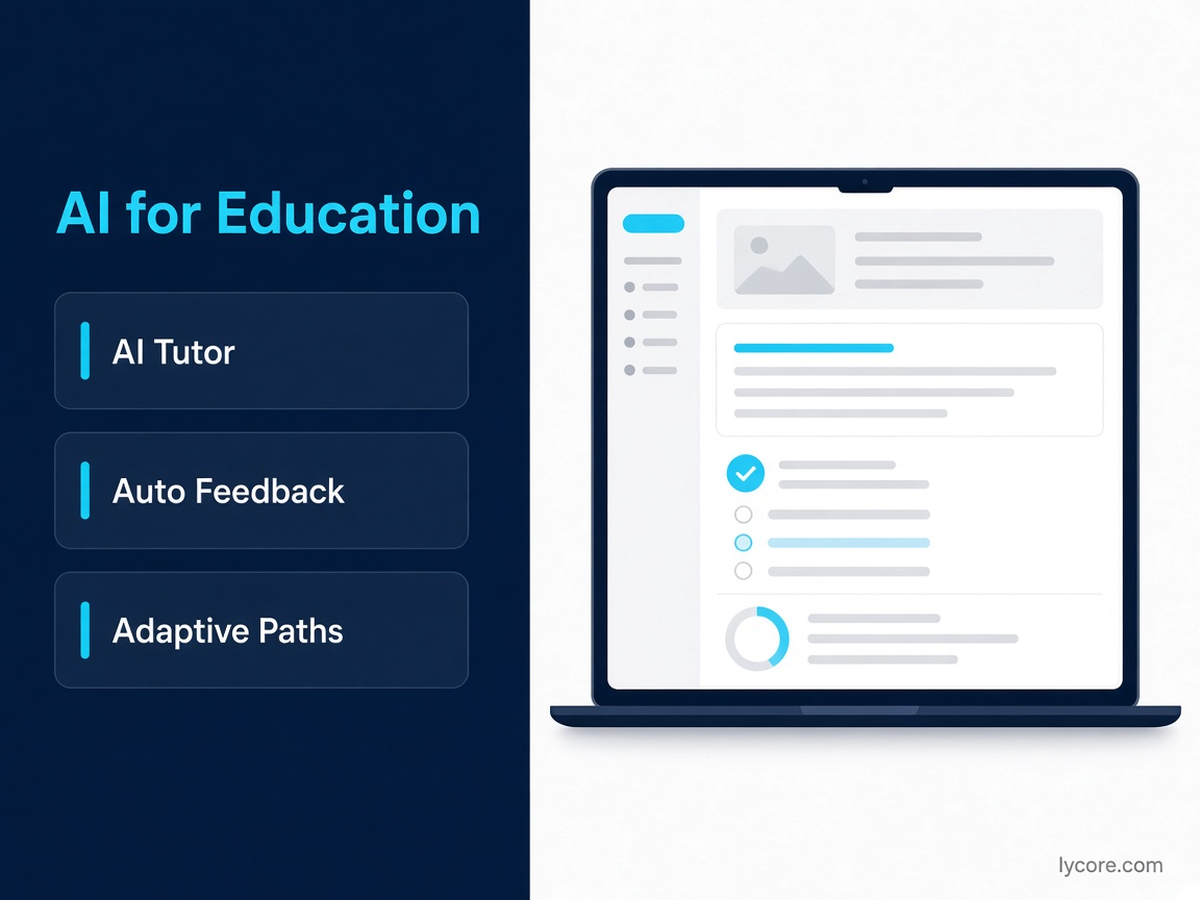
What does AI for education actually do?
AI for education uses language models, learner data and course content to personalize study, speed up assessment and support learners outside class hours. The most useful systems stay grounded in the course or the learner’s own material, show where every answer came from, and leave grading decisions and judgment with teachers.
Every learning platform already holds the data AI needs: course content, question banks, quiz results, session activity and submissions. The work is choosing the few places where AI saves teachers real hours or helps a learner make progress, then building those features with the privacy and accuracy controls that education requires. Below is what we build, how it fits into a learning management system (LMS), and the guardrails we put around it.
AI for education capabilities we build
Each capability can ship as a feature inside your existing LMS or course platform, or as part of a new AI-first learning product.
Adaptive learning paths
Knowledge models based on item response theory and Bayesian knowledge tracing estimate what each learner has mastered after every answer. A path engine then picks the next activity at the edge of their understanding, and spaced repetition schedules review before material is forgotten.
Assessment and automated feedback
Automatic marking for multiple choice, short answers, code exercises and math, with feedback that names the specific misconception instead of a generic “try again”. For essays, AI drafts feedback on structure and evidence for the teacher to review and edit before it reaches the student.
Conversational AI tutors
Tutors built with retrieval-augmented generation (RAG) that answer from your course content, use the instructor’s terminology and cite the lesson they drew on. When the material does not cover a question, the tutor says so rather than guessing.
Learning analytics and early intervention
Dashboards that combine assessment trends, content usage, session frequency and missed submissions. Alerts rely on several weak signals together rather than one threshold, and show instructors exactly which signals triggered them so the follow-up conversation is specific.
Content intelligence and tagging
AI tags video, documents and question banks by learning objective, skill level and format, maps content to competency frameworks during LMS migrations, and powers semantic search so learners find the right lesson by describing what they need.
Study material generation
Summaries, flashcards, practice questions and quizzes generated from approved source material, with each item linked back to the passage it came from so instructors and learners can check it quickly.
How AI fits into your LMS and learning platform
AI features work best as part of the platform learners already use, not as a separate tool. We build on existing LMS data and standards, or build the full stack when a new platform is the better option: a Django and Python backend, a React web front end and Flutter mobile apps.
Course content is split into sections, indexed for search and kept in sync as instructors edit it. Model calls run on the server through a single gateway that handles prompts, logging and per-user limits, so keys never reach the browser and costs stay predictable. We work with Claude, GPT, Gemini and open-weight models, and pick per task: a smaller, faster model for tagging and marking, a stronger one for tutoring and feedback.
Integration points we support
- Content standards: SCORM and xAPI (Tin Can) for existing course libraries and learning records.
- Single sign-on: SAML 2.0 and OAuth 2.0 for school and enterprise identity providers.
- Video: Vimeo, Wistia and YouTube, with transcripts indexed for search and tutoring.
- Assessment engine: custom question types, adaptive branching and timed assessments.
- Certification: automatic certificate generation, expiry tracking and verification.
Guardrails for AI in education
Learners trust what a tutor tells them, and teachers stay accountable for grades. These are the controls we build into every education AI feature.
- Grounded answers with sources. Tutors and generated material cite the section of the course or notes they used, and label anything that goes beyond it.
- Teachers keep the final say. AI marks and drafts feedback; final grades, essay feedback and academic integrity decisions stay with instructors.
- Student data minimization. Only the data a feature needs is sent to a model, through providers you approve, with no training on student data where the provider offers that option.
- Privacy law questions go to counsel. Student records and younger learners raise specific obligations, such as FERPA and COPPA in the US. We build to the controls your legal and privacy advisors specify.
- Limits and logging. Per-user daily limits, a record of every AI request, and a fallback when the AI cannot mark an answer, so a learner can compare with the model answer and continue.
See AI for education in LevelUp
LevelUp is one of the working apps Lycore designed and built. It is an AI study app for students aged 16 and over, on the web, Android and iOS, and anyone can try it as a guest.
Study packs from your own notes
Grounded generation
Students add notes from photos, PDFs or pasted text and check the text first. LevelUp then writes a summary, key concepts, 10 to 30 flashcards and a quiz using only those notes, and each item shows the section it came from.
AI-checked answers and a voice tutor
Assessment and tutoring
Short written answers are checked against the answer key and the notes and marked correct, partly correct or not quite, with one sentence on what was missing. The tutor answers only from the notes and labels anything else as not from your notes.
Spaced repetition and progress
Adaptive review
Flashcard reviews are scheduled with the FSRS algorithm, quiz mistakes turn into flashcards, and a weekly insight points to the weakest concepts. Language learners can also practice conversations with gentle corrections.
Explore LevelUpRelated reading
Deeper guides on building AI education products. For how we scope and price AI work in general, see our AI development services, or browse other sectors in AI for industries.
Frequently asked questions
Can you add AI to our existing LMS instead of replacing it?
Usually, yes. Most AI for education features, such as a course tutor, automated marking or content tagging, can run as a service beside your current LMS, reading content and results through its API or through SCORM and xAPI records and signing users in through your existing SSO. We recommend a new platform only when the current one cannot expose the data or the user experience you need. The first step is a short review of your LMS, your content and the workflow you want to improve.
How do you stop an AI tutor from giving wrong answers?
No AI is perfect, so we design to limit and expose mistakes. The tutor retrieves the relevant sections of your course before answering, is instructed to answer only from them, cites the source and says when the material does not cover a question. We test it against a set of real learner questions before launch, log every exchange so instructors can review them, and give learners an easy way to flag an answer. Grades and high-stakes decisions stay with teachers.
How much does it cost to build AI for education features?
We work at USD 25 per hour offshore, as a fixed project price or a monthly retainer. As an indicative guide, a focused feature such as a course tutor or AI marking in an existing platform usually falls in the USD 7K-15K band, a broader set of features in USD 15K-30K, and a new AI-first learning app in USD 30K-50K or above USD 50K. Model usage is paid to the AI provider and estimated before the build.
What about student privacy laws?
Education data carries real obligations, and they depend on your learners’ ages, your institution type and your state. In the US that can include FERPA for student records and COPPA for children under 13. We treat these as questions for your counsel and build to the controls they set: data minimization, approved AI providers, server-side processing, access controls, retention limits and audit logs. We do not offer legal advice, and we will not guess at what a law requires.
Building AI into your learning platform?
Tell us about your learners, your content and the workflow you want to improve. We will tell you where AI fits, what it would cost and how long it would take.
Talk to Lycore