
AI for Fundraising
Fundraising comes down to three things: finding the right supporters, reaching them with the right message at the right time, and showing what their gifts made possible. Experienced development staff do this well for a manageable portfolio. AI helps the same team cover far more relationships without losing the personal touch.
How does AI for fundraising help a development team?
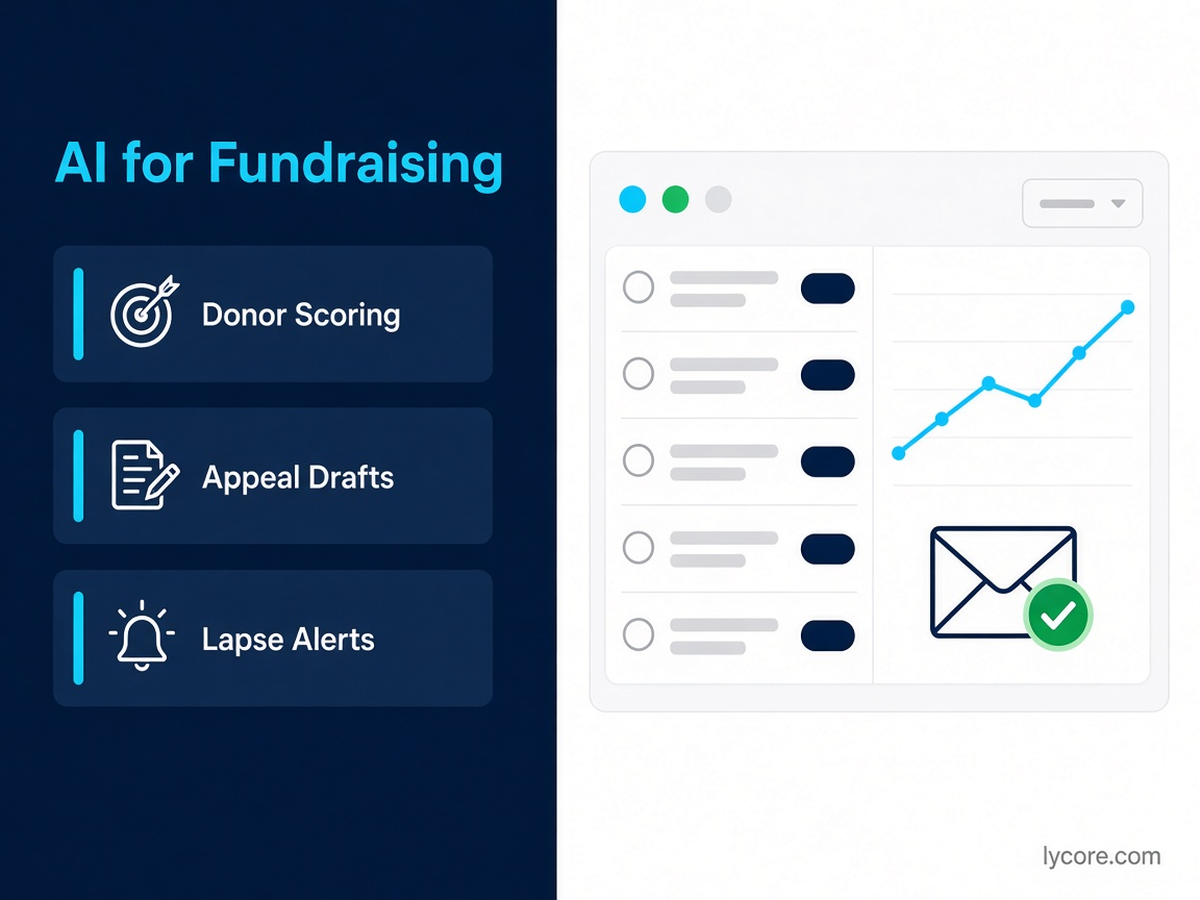
AI for fundraising uses your CRM, giving history and engagement data to rank donors by likely next step, compile prospect research, draft personalized appeals and spot supporters at risk of lapsing. It handles the data work so gift officers can spend their time on conversations, and every message and ask stays under staff approval.
Most fundraising teams already hold the data AI needs in their donor CRM, email platform, event tools and payment records. The problem is time: nobody can read every record before every call. We build AI features that sit on that data, surface the right context at the right moment, and fit into the systems your staff already use every day.
AI for fundraising capabilities we build
Each capability can be added to your existing CRM and fundraising stack or built into a new giving platform.
Donor scoring and portfolio management
Scores that combine giving history, recency and frequency of engagement, event attendance, volunteering, peer-to-peer activity and digital engagement. Scores update as new data arrives, and gift officers get an alert when a donor’s score moves enough to warrant outreach.
Major gift prospect research
Tools that gather public information, such as business roles, board memberships, published philanthropy and news coverage, into a structured prospect brief with sources linked. Researchers review and edit the brief before it reaches a gift officer.
Personalized appeals
Drafts that pick the program story, update and suggested ask most relevant to each donor’s history and interests, written inside a message framework your team approves. Staff edit and send; nothing goes out without review.
Campaign analytics
Analysis across appeals, segments, channels and message versions that shows what drove response for your own donor base, with plain-language summaries and suggestions for the next campaign.
Retention and lapse prevention
Models that flag donors whose engagement pattern looks like past lapsed donors: fewer gifts, lower open rates, no response to recent appeals. Flags arrive while the relationship is still warm, with a suggested next step.
CRM assistant for gift officers
An assistant that answers questions about a donor or segment from your CRM, prepares a call brief before a meeting and drafts the contact report afterward for the officer to approve.
How we build AI for fundraising teams
We start with your CRM, whether that is Salesforce Nonprofit Cloud, Blackbaud Raiser’s Edge, a custom system or a spreadsheet that grew up. A sync job brings giving, engagement and event data into a clean store, and scoring models run on a schedule and write scores back to the donor record, so staff see them where they already work.
Language models from the Claude, GPT and Gemini families, or open-weight models, write briefs, appeals and summaries. They run on the server, receive only the fields a task needs, and every request is logged. Drafts land in a review queue, not an outbox. For predictive scores, we keep the reasons visible, such as “gave in each of the last three years, attended the spring event”, so officers can judge whether the score makes sense.
Data sources we connect
- CRM: donor records, gift history, contact reports and portfolio assignments.
- Engagement: email opens and clicks, event check-ins, volunteer hours and peer-to-peer pages.
- Payments: one-time and recurring gifts from your payment provider, such as Stripe.
- Public sources: only those your policy allows, with each fact linked to its source.
Guardrails for AI in fundraising
Donors give because they trust your organization. AI should protect that trust, not spend it.
- Staff approve every message. AI drafts appeals, thank-you notes and asks; people review, edit and send them.
- Donor privacy is a question for counsel. Prospect research, data sharing with AI providers, email and texting consent and state privacy laws all carry obligations. We build to the policies your counsel and leadership set.
- Minimal data to models. Only the fields a task needs are sent, through providers you approve, with no training on your data where the provider offers that option.
- Explainable scores. Every score shows the signals behind it, and scores inform priorities; they never decide who is worth talking to on their own.
- Respect for donor wishes. Opt-outs, communication preferences and do-not-solicit flags are enforced in code before any draft is created.
What AI for fundraising costs
Lycore is a US-registered software company with an offshore engineering team, and we have delivered more than 300 projects across more than 30 industries. We work at USD 25 per hour, as a fixed project price or a monthly retainer. These indicative bands help with early budgeting:
AI model usage is paid to the provider and estimated before the build. See our AI development services for how we scope and run AI projects.
Related reading
More on fundraising software, CRMs and responsible AI. You can also browse other sectors in AI for industries.
Frequently asked questions
Can AI for fundraising work with our existing CRM?
In most cases, yes. If your CRM has an API or a reliable export, we can sync donor, gift and engagement data, run scoring and drafting on our side, and write scores, briefs and drafts back to the donor record. Staff keep working in the system they know. If your data lives in several tools, the first phase joins it, which also gives your team a single view of each supporter. We confirm what your CRM allows before quoting.
Will AI-written appeals sound generic?
Not if they are built properly. We give the model your approved voice, past appeals that worked, the donor’s history and the specific program story, and ask for a draft inside that frame. A person then edits and approves it. The AI saves the time spent assembling context and writing the first version; your team supplies the judgment and warmth. We also track which drafts staff change most, so the prompts improve over time.
Is it acceptable to use AI for prospect research?
Prospect research is an established practice, but how you gather and use information about people matters. We build tools that use only the public sources your policy allows, link every fact to its source and keep researchers in charge of what goes into a brief. Questions about privacy law, consent and data retention should go to your counsel, and we build to the rules they set. Many organizations also publish a donor privacy statement.
What data do we need before starting with AI for fundraising?
Less than you might think. Donor scoring and lapse alerts need a few years of gift history with dates and amounts, plus whatever engagement data you track, such as email activity or event attendance. Appeal drafting and call briefs can work from your current CRM records and a set of past appeals in your voice. Messy data is normal: the first phase usually cleans and joins it, which helps your team even before any model runs.
Bringing AI to your fundraising team?
Tell us about your donors, your CRM and where your team’s hours go. We will tell you where AI fits, what it would cost and how long it would take.
Talk to Lycore