
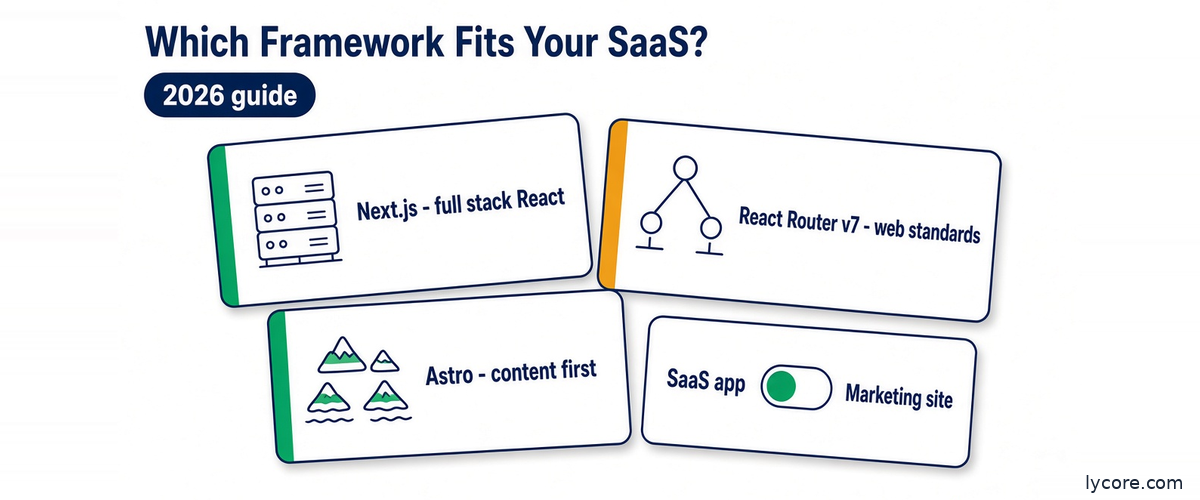
Ask an AI coding tool such as v0, Lovable, Bolt, Cursor or Claude Code to scaffold a SaaS and there is a good chance you get a Next.js App Router project with Tailwind, shadcn/ui, Postgres and a Vercel deploy button. That default is not wrong, but it is a default, not a decision. The Next.js vs Remix vs Astro question is really three questions: how much of your product is interactive application versus content, how much control you want over where it runs, and how much framework surface area your team (and your AI tools) can keep in their heads. This guide compares the three as they stand in November 2026, with the details that matter when you are the one maintaining the code a year from now.
Key takeaways
- In Next.js vs Remix vs Astro, Next.js is the broadest full-stack React option, React Router v7 is the most web-standards-shaped, and Astro fits best when most pages are content.
- Evaluating Remix for a React app in 2026 means installing React Router v7 framework mode, since Remix v2 merged into it in November 2024 and Remix 3 will not depend on React.
- Astro ships no client JavaScript unless a component is opted into hydration as an island, which gives content-heavy, SEO-driven pages the smallest payloads with the least effort.
- Next.js runs all features on a Node.js server or Docker container, but some capabilities need extra work outside Vercel, so teams unsure of future hosting should avoid single-host features.
- A practical split for early-stage SaaS uses Astro for the marketing site, blog and docs on the root domain and Next.js or React Router v7 for the logged-in app on a subdomain.
Next.js vs Remix vs Astro: The Short Version
Before going deep, it helps to be precise about what each name means today, because two of the three have changed shape in the last two years.
Next.js: the full-stack React default
Next.js is the React framework maintained by Vercel. The current line is Next.js 16, with 16.4 released in October 2026. Its App Router is built around React Server Components, Server Actions, streaming, and a caching model that Next.js 16 reorganized under the name Cache Components. It does everything: static pages, server rendering, API route handlers, image optimization, middleware (now called Proxy in the docs), and incremental regeneration. That breadth is the reason AI tools reach for it, and also the reason it has the steepest learning curve of the three.
Remix: now React Router v7, with Remix 3 on a different path
If you are evaluating “Remix” for a React app in 2026, what you actually install is React Router v7 in framework mode. The Remix team merged Remix v2 into React Router v7 in November 2024 and encouraged all Remix v2 users to upgrade. Framework mode keeps the Remix ideas that people liked: route modules with loaders and actions, server rendering, nested routes, a Vite-based compiler and strong type safety. Separately, the team announced in May 2025 that Remix 3 will be a new framework that does not depend on React. For a production React SaaS today, React Router v7 is the stable, supported path, and that is what we mean by “Remix” in the rest of this article.
Astro: content first, islands of interactivity
Astro renders pages to HTML on the server or at build time and ships no client JavaScript unless you opt a component into hydration. Those interactive components are “islands”, and they can be React, Vue, Svelte, Solid or Preact. Astro 6 shipped in March 2026 with stable Live Content Collections, a stable Content Security Policy API and a built-in Fonts API. In January 2026 the company behind Astro joined Cloudflare; the announcement states Astro stays MIT-licensed and that the team will keep supporting deployments to all targets, not just Cloudflare.
The one-line summary: Next.js is the broadest, React Router v7 is the most web-standards-shaped React option, and Astro is the best fit when most of what you serve is content.
Rendering and Data Loading: How Each Framework Thinks
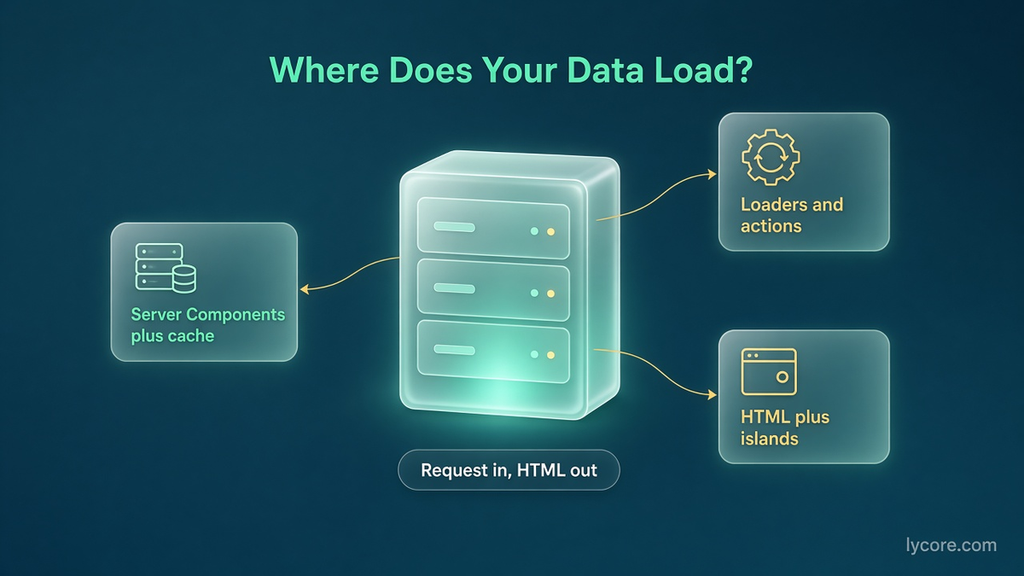
The biggest practical difference between the three is not syntax. It is where data gets fetched, where it gets cached, and how a form submission flows back to the server.
Next.js: Server Components, Server Actions and caching
In the App Router, a page is a tree of components. Server Components run only on the server and can query Postgres directly; Client Components (marked with ‘use client’) hydrate in the browser. Mutations typically go through Server Actions, which are functions the client calls by an encrypted ID. Caching is layered: fetch results, rendered segments, and full routes can all be cached and later invalidated with revalidateTag or revalidatePath. The newer ‘use cache’ directive makes caching explicit at the function or component level. The power here is real: you can stream a dashboard shell instantly and fill slow widgets later. The cost is cognitive. Most production bugs we see in Next.js codebases are caching bugs, where a page shows stale data after a mutation, or a user-specific value accidentally lands in a shared cache.
React Router v7: loaders, actions and the web platform
Each route module exports a loader (runs on the server for GET requests), an action (runs for POST, PUT, DELETE), and a component. Forms are real HTML forms that work without JavaScript and get progressively enhanced. After an action completes, the framework revalidates the loaders on the page automatically, so the “stale after mutation” class of bugs mostly disappears. Caching is left to standard HTTP Cache-Control headers and whatever CDN you put in front. For a CRUD-heavy SaaS with tables, filters and forms, this model is easy to reason about and easy to test, because loaders and actions are plain request-in, response-out functions.
Astro: HTML by default, server islands when needed
Astro pages fetch data in the component frontmatter at build time (static) or per request (server output). Interactive pieces are islands with directives like client:load or client:visible. Server islands let you defer a personalized fragment, such as a signed-in avatar or cart count, while the rest of the page stays cacheable. Astro also has Actions for type-safe form handling. It is excellent for a marketing site, docs, a blog or a changelog. It becomes awkward when the whole screen is application state, such as a drag-and-drop board or a live dashboard, because at that point you are building a single-page app inside one giant island.
Hosting and Lock-In: Where Each Framework Runs Best
Framework choice quietly becomes a hosting choice. This is where founders get surprised a year in, when the hosting bill or a compliance requirement pushes them to move.
Next.js: runs anywhere, best on Vercel
The Next.js deployment docs (updated 2026) state that a Node.js server or Docker container supports all Next.js features. Next.js 16.2 introduced a stable Deployment Adapter API in March 2026, and the docs list Vercel and Bun as verified adapters, with Cloudflare and Netlify working on verified adapters while they run their own integrations. In practice, Vercel is still where every feature works with zero configuration: ISR, image optimization, skew protection, streaming and preview deployments. Self-hosting is fully possible, but you take on a shared cache handler, a consistent Server Actions encryption key across instances, and a deployment ID for version skew. None of that is hard, but it is work that AI-generated scaffolds rarely set up for you.
React Router v7: a request handler you can put anywhere
Framework mode builds to a standard Fetch API request handler. The official templates include a Docker image for a VPS and a Cloudflare Workers target, and community adapters cover Express, Netlify, Vercel and AWS. Because caching is plain HTTP, moving hosts does not change application behavior. If you expect to run on your own AWS account for enterprise customers, or you simply want the option, this is the most portable of the three.
Astro: static anywhere, server output via adapters
A static Astro build is just files, so it runs on any CDN or object store. Server output uses adapters for Node, Cloudflare, Netlify and Vercel. Since Astro 6, the Cloudflare adapter runs the workerd runtime in development, prerendering and production, which removes a whole class of “works locally, breaks on Workers” bugs. The Cloudflare ownership is worth noting: the commitment to all deployment targets is stated publicly, and the code is MIT, so a fork is always possible, but expect Cloudflare-specific features to land first.
Our rule of thumb: if you are unsure where you will host in two years, avoid building on features that only one host implements fully. That applies to every framework, but Next.js has the most such features.
Developer Experience and AI Coding Tools
Many teams now write a large share of their code with AI assistance, so how well your framework plays with those tools is a legitimate selection criterion. We wrote about our own workflow in how we use AI tools to deliver projects faster; here is how it plays out per framework.
Next.js: the most training data, the most outdated patterns
AI models have seen enormous amounts of Next.js code, and generators like v0 are built by Vercel around it. The catch is that much of that code is Pages Router or early App Router, written before the caching defaults changed. We regularly see generated code that mixes getServerSideProps with the app directory, or wraps everything in ‘use client’ and fetches in useEffect, which throws away the benefits of Server Components. The Next.js team has leaned into this problem: Next.js 16.2 added an AGENTS.md file to create-next-app, and 16.3 shipped first-party agent Skills and error messages with paste-ready fix prompts. Use them, and pin your Next.js version in the agent instructions.
React Router v7: smaller surface, easier to review
There are fewer concepts to get wrong. A loader, an action, a component and a form cover most screens. When an AI agent produces a route module, a reviewer can check it in a minute: is input validated in the action, does the loader check the session, are errors handled by the route ErrorBoundary. The name change from Remix causes some confusion in generated code (imports from @remix-run packages instead of react-router), so tell your agent explicitly which version you use.
Astro: simple templates, mixed-framework risk
Astro components look like HTML with a frontmatter block, so generated pages are easy to read. The risk is sprawl: because Astro accepts React, Vue and Svelte islands, an agent may pull in a second UI framework to solve one widget. Set a rule (for example, React islands only, styled with Tailwind and shadcn/ui) and enforce it in review.
Next.js vs Remix vs Astro for Common SaaS Scenarios
Abstract comparisons only go so far. Here is how we would choose for the products US founders most often bring us. For broader product advice, see our guide to building a SaaS product.
B2B dashboard SaaS with forms, tables and roles
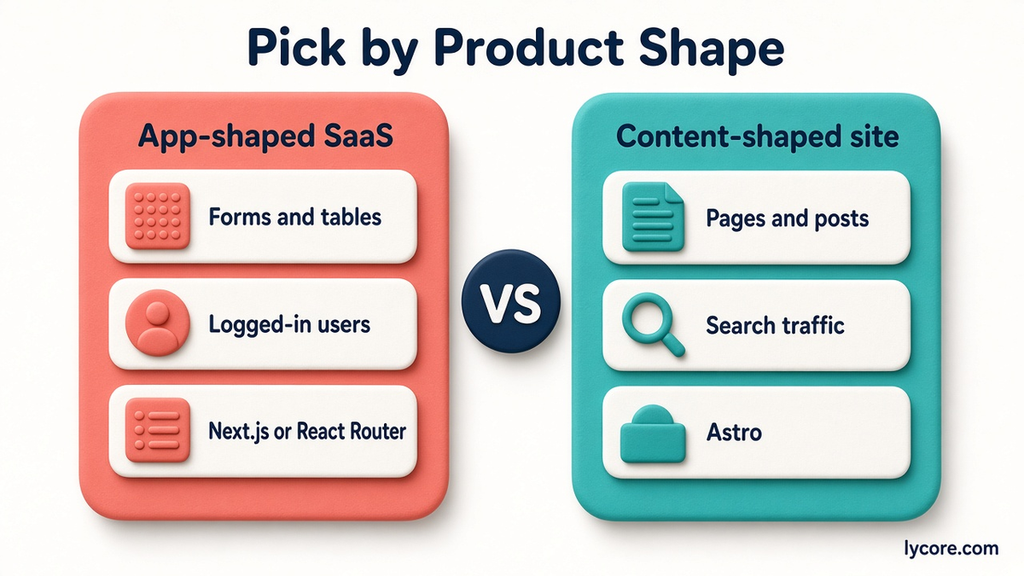
Think a project management tool, a care operations back office or an internal ops console. Both Next.js and React Router v7 are good fits. Choose Next.js if you want the largest hiring pool, plan to deploy on Vercel, and have someone on the team who will own caching rules. Choose React Router v7 if you want predictable mutation flows, expect to self-host or deploy into a customer’s cloud, or your team is coming from a classic server-rendered background such as Rails or Django. Astro is the wrong primary choice here.
Content-heavy product: docs, marketplace listings, directories
If most pages are read far more than they are written, and SEO drives acquisition, Astro gives you the smallest JavaScript payloads with the least effort. Next.js with static generation and ISR is the alternative when the content site and the app must share components and a single deployment.
Marketing site plus app, split
A pattern we like for early-stage SaaS: Astro for the marketing site, blog and docs at the root domain, and Next.js or React Router v7 for the logged-in app on an app subdomain. Each side is optimized for its job, marketing can ship without touching app code, and a broken blog deploy never takes down billing. The cost is two build pipelines and a shared design system package, which is a fair trade once you have more than a handful of marketing pages.
| Factor | Next.js | React Router v7 (Remix) | Astro |
|---|---|---|---|
| Best fit | Full-stack React apps of any size | Form and data-heavy apps, portable deploys | Content sites, docs, marketing |
| Client JS by default | React runtime plus client components | React runtime plus route code | None unless islands are hydrated |
| Mutations | Server Actions, route handlers | Route actions with HTML forms | Astro Actions, API endpoints |
| Caching model | Framework caches plus revalidation APIs | Standard HTTP caching | Static build or HTTP caching |
| Smoothest host | Vercel | Any Node or Workers host | Any CDN; Cloudflare for server output |
| Learning curve | Steepest | Moderate | Gentle |
Performance, SEO and the Stack Around the Framework
All three frameworks can produce fast pages. The differences show up at the edges: how much JavaScript ships by default, how easy it is to accidentally make a page dynamic, and how they fit with the rest of the usual AI-era stack.
JavaScript weight and Core Web Vitals
Astro wins on content pages because nothing hydrates unless you ask. Next.js and React Router both ship the React runtime plus route code, which is fine for an app behind a login but adds weight to landing pages. In Next.js, a single client-side import at the top of a layout can pull a large library into every page; the bundle analyzer tools added in recent releases help find these. In React Router, route-level code splitting is automatic, and the main risk is a heavy root layout.
SEO
All three render HTML on the server, so search engines see real content. Next.js has the richest metadata API (generateMetadata, dynamic Open Graph images). React Router uses a meta export per route. Astro gives you direct control over the head in a layout component. None of them will fix thin content, slow APIs or a missing sitemap.
Tailwind, shadcn/ui, Postgres, Stripe and auth
The surrounding stack is mostly framework-agnostic. Tailwind works everywhere. shadcn/ui components are React, so they drop into Next.js and React Router directly and into Astro as React islands. Postgres access through Drizzle or Prisma works in all three on a Node runtime; on Workers you need a driver and connection approach that suits that runtime. Stripe Checkout and webhooks are plain server code. Auth libraries differ the most: some are built around Next.js conventions, so check that your chosen auth provider has first-class support for your framework before you commit. Our post on why teams choose React covers the ecosystem side in more depth.
Long-Term Risk: Churn, Governance and Upgrades
A SaaS codebase lives for years. The framework you pick will go through several major versions in that time, so judge each on how it changes, not only on what it does today.
Next.js release cadence and security
Next.js ships a minor release every few months and, since mid-2026, follows a formal monthly security release process, with out-of-band patches when upstream issues demand them. The December 2025 React Server Components vulnerability (CVE-2025-66478) was a reminder that server-side React is real attack surface. Budget for monthly dependency updates and a test suite that lets you take them without fear. The caching model has changed meaningfully between major versions, so upgrades are not always mechanical.
React Router and the Remix rename
React Router is one of the oldest libraries in the React ecosystem and has a long record of providing upgrade paths. The Remix-to-React-Router merge was handled with codemods and an upgrade guide. The open question is attention: with Remix 3 going in a non-React direction, watch how actively React Router v7 framework mode is developed. The team has described it as a stable platform with long-term support, which is what you want from a foundation.
Astro under Cloudflare
Astro has a reputation for clean major upgrades and good migration guides. Cloudflare’s backing removes the question of whether the project is funded; it introduces the question of priorities. For a content site, the risk is low: static output is portable by nature, and you can always build to plain files.
Pros and Cons of Next.js vs Remix vs Astro
Pros
- Next.js: one framework for marketing pages, app, API and images; the largest ecosystem and hiring pool; first-class support in AI generators; zero-config deploys on Vercel.
- React Router v7: simple loader and action model; forms work without JavaScript; automatic revalidation after mutations; highly portable across hosts; easy to review.
- Astro: near-zero JavaScript on content pages; mix-and-match UI islands; stable CSP and content APIs in Astro 6; static builds run anywhere.
Cons
- Next.js: complex caching model; frequent patch releases to track; some features need extra work outside Vercel; AI tools often generate outdated patterns.
- React Router v7: naming confusion with Remix; fewer batteries included (no built-in image optimization); smaller pool of tutorials than Next.js.
- Astro: not built for highly interactive app screens; mixed UI frameworks can creep in; vendor priorities now tied to Cloudflare.
Frequently Asked Questions
Is Remix dead in 2026?
No, but it has been renamed for React users. Remix v2’s features now live in React Router v7 framework mode, released in November 2024, and the Remix team recommends that Remix v2 apps upgrade to it. The “Remix” brand is being used for Remix 3, a separate framework the team announced in May 2025 that does not depend on React. So if you want the Remix programming model for a React SaaS today, install React Router v7 and follow its framework mode docs. Existing Remix v2 apps can keep running, but plan the upgrade, because new fixes and features land in React Router. When hiring, look for React Router v7 experience as well as Remix experience, since the concepts are the same.
Can I build a full SaaS app in Astro?
You can, using server output, Astro Actions, middleware for sessions and React islands for interactive screens. Some teams do it successfully for products that are mostly read-only or form-driven with light interactivity. The trouble starts when most screens are stateful: drag-and-drop, real-time updates, complex client-side filtering, or multi-step wizards that share state. At that point you end up with large islands that behave like a single-page app, and you lose Astro’s main advantage while taking on its constraints. For those products, keep Astro for the public site and build the logged-in product in Next.js or React Router v7. That split also lets marketing and product deploy independently.
Should I switch frameworks if my AI tool generated a Next.js app?
Usually not. If the generated app works and your team can maintain it, the switching cost rarely pays off. What we recommend instead is a short hardening pass: confirm you are on the current Next.js major and patch version, remove unnecessary ‘use client’ directives, move data fetching into Server Components or route handlers, review every Server Action for authentication and input validation, and write down your caching rules so the next person (or agent) follows them. Switching makes sense when there is a concrete driver, such as a requirement to run in a customer’s cloud with minimal operational work, a content site that is paying for app-grade infrastructure, or a team that keeps shipping caching bugs despite clear guidelines.
Which framework is cheapest to host?
For pure content, a static Astro build is the cheapest because it is just files on a CDN, and several hosts serve static assets at very low or no cost. For applications, the framework matters less than the hosting model and your traffic pattern. Next.js on Vercel is billed on usage, React Router on a container or Workers is billed on whatever that platform charges, and any of them can run on a small virtual server. What drives cost is how much of your traffic needs server rendering, how much is cacheable, and how many image transformations and function invocations you generate. Model your expected requests and check current pricing on each host before deciding, rather than assuming one framework is inherently cheaper.
Conclusion
There is no universal winner in Next.js vs Remix vs Astro, but there is usually a clear answer for a specific product. If you are building an application-shaped SaaS and want the biggest ecosystem, Next.js is a sound default, provided someone owns its caching model and upgrade cadence. If you value a small, predictable mental model and want to deploy anywhere, React Router v7 framework mode is the strongest React alternative. If your product is mostly content, or you need a fast marketing site in front of your app, Astro is hard to beat. Pick based on the shape of your product and your hosting plans, not on what the AI scaffold happened to generate. If you are still at the idea stage, our MVP development page explains how we scope a first version so that framework choice stays reversible.
Building a SaaS on Next.js, React Router or Astro? Talk to Lycore. Our offshore team works at USD 25 per hour, on a fixed price or a monthly retainer, and you can try the working apps we have built on Our Work.