
AI for Trading Agents and Brokers
Research automation, signal research pipelines, execution tools and capital management software for brokers, prop firms, trading desks and fintech teams, built with risk controls, audit trails and people in charge of every risk decision.
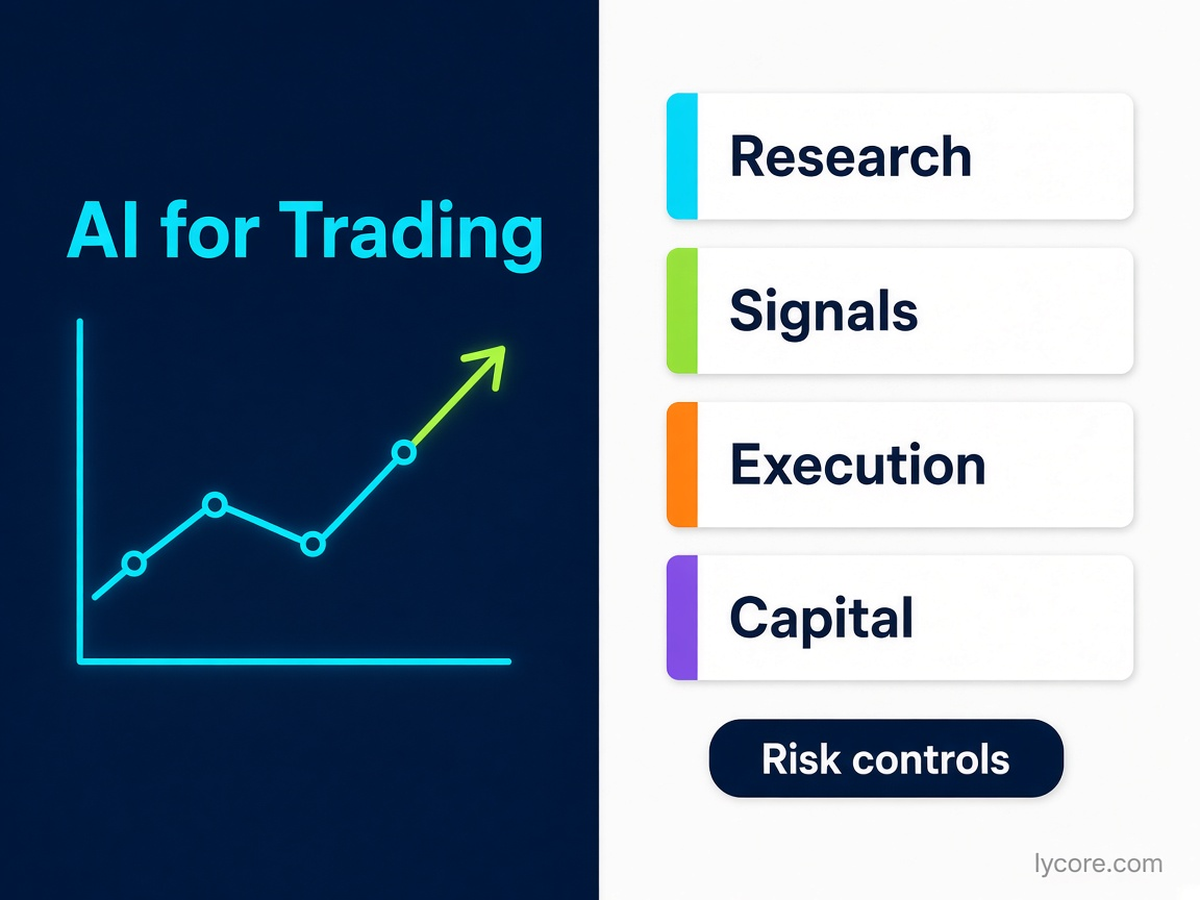
What does AI for trading look like in practice?
AI for trading means software that helps brokers and trading firms process market data, documents and account activity faster: research summaries, signal research pipelines, execution tooling, risk monitoring and operator analytics. It supports research and execution. It does not replace the people who decide what to trade or how much risk to take.
Trading is a domain where software mistakes are expensive, so AI here is built differently from a generic chatbot. Latency matters, data quality matters more, and every automated action needs a limit, a log and a person who can stop it. Lycore is a US-registered software company with an offshore engineering team, and we build these systems as part of our wider AI development services.
This page covers the four areas we build most often for trading businesses, what makes trading AI different, the technology we use and the guardrails we put around it. Each capability below links to a detailed guide.
AI capabilities for trading firms and brokers
What we build, the data each piece uses and where it plugs into the systems you already run.
AI stock research
Pipelines that ingest financial statements, earnings call transcripts, regulatory filings and news, then produce structured summaries, peer comparisons and change alerts for analysts, with a source link on every figure.
Signal generation infrastructure
Point-in-time data pipelines, feature stores and validation tooling that your quant researchers use to define, backtest and monitor their own signals, with walk-forward testing and cost modeling built in.
Automated trading bots and tools
Execution algorithms, strategy automation, crypto exchange connectivity and backtesting infrastructure, with position limits, loss limits and kill switches enforced in the order path.
Capital management
Position sizing services, portfolio risk monitoring, tiered drawdown controls and multi-strategy allocation tools that apply the limits your risk team sets and log every calculation.
Operator and risk analytics
Natural-language questions over your own account, trade and breach data, answered from read-only database queries with links back to the records, for risk, compliance and operations staff.
Trader coaching and support
Plain-language explanations of rule warnings, trade journal tagging and behavior summaries for traders, built so the assistant refuses requests for trade ideas or market views.
What makes trading AI different
The models are rarely the hard part. The hard part is everything around them: data that arrives late or wrong, systems that must keep up with the market, and automation that can lose money faster than a person can react. We design for those risks first.
- Latency is an architecture requirement. In-memory feature caching, vectorized Python with NumPy and pandas, Redis for shared state, and direct WebSocket or FIX connectivity where the use case needs it.
- Data quality comes before models. Stale prices, outliers, missing bars, corporate action adjustments and currency consistency are checked before any model or person sees the data, and quality is monitored in production.
- Risk controls are part of the design. Position limits, loss limits, kill switches and anomaly detection are built into the first release, not added after something goes wrong.
- One source of truth. Calculations that affect limits run in one server-side engine. AI explains and summarizes those results; it never computes them separately.
Our trading technology stack
- Research and strategy: Python, NumPy, pandas and vectorized backtesting engines.
- Real-time state: Redis and in-memory caches.
- Connectivity: CCXT for crypto exchanges, FIX adapters, REST and WebSocket APIs.
- Models: XGBoost and LightGBM for tabular data, sequence models for time series, and Claude, GPT, Gemini or open-weight models for text.
- Storage: PostgreSQL for orders, trades and audit logs, time-series storage for market data.
- Monitoring: P&L, position and risk dashboards with alerts as limits approach.
Guardrails for AI in regulated trading
Trading firms answer to clients, risk committees and regulators. We build the controls in from the first sprint and leave the policy decisions with you.
- No trade advice from AI. Assistants are instructed never to give buy, sell or hold suggestions, price predictions or market views, and responses are checked for advice-like content before they are shown.
- People keep risk decisions. Systems calculate, flag and enforce the limits you configure. Changing a limit, approving a payout or restarting a halted strategy stays with authorized staff.
- Everything is logged. Every order, limit change, override and AI request is recorded with who did it and when.
- Data stays where you approve. API keys and market data credentials stay on the server, and client data goes only to AI providers your compliance team has approved.
- Regulatory questions go to your counsel. Requirements differ by product, market and jurisdiction, so we build to the specification your compliance team and your regulators set.
None of our trading work comes with performance or return claims. We build software that supports research and execution; results depend on your strategies and your decisions.
See trading AI in a working app
LyTrade is one of the working apps on our work page. It is the software a proprietary trading firm runs on, not a prop firm itself, and all trading in it is simulated, with sandbox payments and no real funds.
LyTrade
Trading: software a prop firm runs on, with simulated trading
It has two sides: a trader app, where traders buy an evaluation challenge, trade a simulated account and watch their rules tracked live, and an operator console, where the firm’s staff configure plans and rules, monitor breaches and review payouts.
- Server-side rules engine. Fills orders, computes P&L and checks every rule on each price tick and fill. A hard-rule breach closes positions, cancels pending orders and fails the account.
- AI risk coach. Phrases deterministic warnings using the engine’s exact numbers, tags closed trades and writes journal entries, and refuses every request for trade ideas.
- AI risk analyst. Answers operator questions from read-only queries of the firm’s data, with links to the underlying records.
- Payout review assist. Summarizes a funded account’s trading and flags rule-relevant concerns. A person makes the decision.
- Audit log. Records every operator action, rule change, breach, payout decision and AI request, with who and when.
The same patterns, deterministic engines, AI that only explains, read-only analytics and human decisions, are the ones we use in client trading systems.
Related reading on trading technology
Longer technical guides from our blog on building trading software and AI.
AI-powered trading software and algorithmic bots
Algorithmic trading platforms: backtesting and live execution
How to build a trading platform: essential features
Data science trading systems: architecture lessons
Financial news sentiment analysis for real-time trading
Real-time compliance risk dashboard: build guide
Explore every AI for industries guide, or see how we scope, build and price AI work on our AI development services page.
Frequently asked questions
What kinds of trading businesses do you build AI for?
Brokers, proprietary trading firms, trading desks, research teams and fintech companies building trading products. The work ranges from one AI feature in an existing platform, such as a research summary pipeline or an operator analytics assistant, to complete systems with execution, risk and reporting. We have delivered more than 300 projects across more than 30 industries, and every trading engagement starts from one workflow with a clear before and after, not from a generic template.
Will your AI tell us or our clients what to trade?
No. We build software that supports research, execution and risk monitoring. We do not provide trade ideas, signals as a service, price predictions or performance claims, and we do not build assistants that give buy, sell or hold suggestions to traders or clients. Assistants are instructed to refuse those requests and their responses are checked before they are shown. Which strategies run, how much risk they take and when to change a limit are decisions that stay with your people.
How much does an AI for trading project cost?
We work at USD 25 per hour offshore, on a fixed project price or on a monthly retainer. As an indicative guide, a focused AI feature in an existing trading platform usually falls in the USD 7K-15K band, a research pipeline or risk monitoring tool in the USD 15K-30K band, and a full execution or capital management platform with integrations in the USD 30K-50K band or above USD 50K. Market data, exchange and AI model usage fees are paid to those providers, and we estimate them before the build starts.
How do you handle regulatory and compliance requirements?
We build the controls in from the first sprint: role-based access, server-side processing, approved AI providers only, complete audit logs and human approval of decisions that matter. What those controls must satisfy depends on your products, your markets and your regulators, so the requirements come from your counsel and compliance team, and we build to the specification they give us. We do not give legal or regulatory advice ourselves.
Building AI for your trading business?
Tell us about the workflow, data and systems you have. We will tell you where AI fits, what it would cost and how long it would take.
Talk to Lycore