
AI Based Stock Research for Analyst Teams
Equity research means reading financial statements, earnings calls, filings and news across a whole coverage list. We build AI tools that handle the gathering, extraction and first-pass synthesis, so analysts spend their time on judgment.
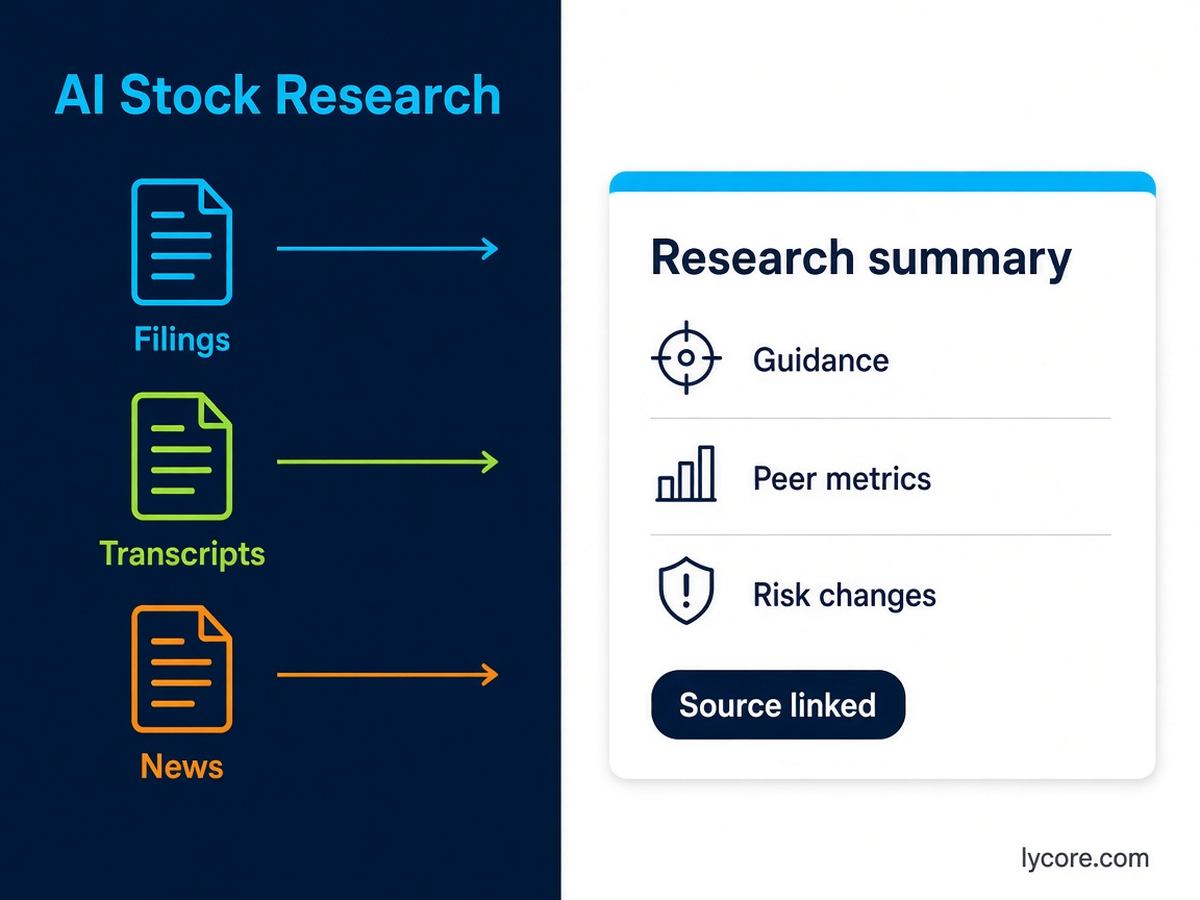
What is AI stock research?
AI stock research uses data pipelines and language models to collect, extract and summarize the material analysts read: financial statements, earnings call transcripts, regulatory filings and news. It speeds up information gathering and first-pass analysis. Forming a view on a company, and any recommendation, stays with the analyst.
The material behind thorough coverage always exceeds what a team can read in the time available, so coverage becomes selective and earnings season becomes a scramble. Research tools change that ratio. They do not produce price targets or ratings; they produce structured, sourced inputs that an analyst checks and builds on.
We build these tools for research teams, brokers and investment firms as part of our AI development services. Below are the capabilities we build most often, how the pipeline works and the guardrails we put around it.
Stock research AI capabilities we build
Each capability runs on your data sources and delivers into the tools your analysts already use.
Financial statement analysis
Ingests income statement, balance sheet and cash flow data from filings or your data vendor, computes margins, returns, leverage, working capital and cash conversion, and compares them with a configurable peer group and the company’s own history.
Earnings call transcript analysis
Extracts forward guidance on revenue, margins and key metrics, tracks how management language and emphasis change across calls, and flags new risk mentions, with every item linked to the transcript passage.
Filing and risk disclosure tracking
Compares risk factors between filing periods to show what was added, reworded or removed, and extracts insider transaction and related-party disclosures into a reviewable list.
News and alternative data monitoring
Classifies news and other feeds by company, topic and materiality, removes duplicates and pushes structured alerts into Slack, Microsoft Teams or email instead of another dashboard to watch.
Research assistant over your library
A retrieval-augmented assistant over your internal notes, models and filings that answers with citations and respects each user’s document permissions.
Model and note integration
Structured outputs that populate spreadsheet models, research note templates and internal APIs, so summaries need light editing rather than retyping.
How an AI stock research pipeline works
Every pipeline follows the same five stages. The language model sits in the middle, surrounded by deterministic code that controls what goes in and checks what comes out.
- Ingest. Filings from SEC EDGAR, transcripts and fundamentals from vendors you already license, and news feeds, stored as raw documents with timestamps.
- Normalize. Documents are split into sections and tables, mapped to tickers and fiscal periods, and stored point-in-time so history is never overwritten.
- Extract. Models from the Claude, GPT or Gemini families, or open-weight models where data must stay in your environment, return structured output validated against a schema.
- Verify and index. Figures are cross-checked against source tables, then indexed for hybrid keyword and vector search, for example PostgreSQL with pgvector.
- Deliver. Alerts, summaries and data feeds go to analysts, each statement linked to its document, section and page.
What analysts get
- Summaries shortly after documents are published.
- Peer comparison tables on consistent metric definitions.
- A guidance change log across quarters.
- Risk factor diffs between filings.
- Source links on every number and quote.
Guardrails for research AI
Research output can influence investment decisions, so the controls matter as much as the extraction quality.
- Sources on every output. No unsourced numbers or quotes. If a statement cannot be traced to a document, it is not shown.
- No ratings or recommendations from AI. The tools summarize and compare. Ratings, price targets and buy or sell views are never generated.
- Licensed data respected. Vendor terms on caching and AI processing are checked with your team before any feed is connected.
- Access controls on sensitive material. Permissions, logging and information barriers follow the policies your compliance team sets.
- Human review before distribution. Anything that reaches clients goes through your existing research review and approval process.
Questions about research distribution rules and disclosures belong with your counsel and compliance team; we build to the requirements they specify.
The same pattern in LyTrade
LyTrade, one of our working apps, is the software a proprietary trading firm runs on. Trading in it is simulated and checkout uses sandbox payments. Its operator side shows the research pattern we use: AI that answers from the firm’s own data and always shows its sources.
LyTrade
Trading: software a prop firm runs on, with simulated trading
Operators get an AI risk analyst for questions over the firm’s data, and payout requests come with an AI summary. In both cases a person reads the evidence and decides.
- Read-only queries. The AI analyst answers natural-language questions, such as which funded traders had a drawdown over 6% this week, using read-only queries of the firm’s data.
- Links to records. Every answer links to the underlying records, so staff can check the evidence.
- Summaries that flag, not decide. Payout review assist summarizes an account’s trading and flags concerns such as one day making up most of the profit.
- No trade ideas. Requests for trade ideas or market views are refused with the same answer every time.
- Logged requests. Every AI request is written to the audit log with who and when.
Swap trader accounts for company filings and the architecture is the same one we use for research tools.
Related reading
Technical guides from our blog on the building blocks behind research AI.
Financial news sentiment analysis for real-time trading
Hybrid AI search with Django: implementation guide
MCP vs RAG: when to use each for AI applications
AI trading strategy: faster insights from your data
Data science trading systems: architecture lessons
How to integrate AI into an existing web application
More trading guides: AI signal generation, automated trading bots and tools and AI capital management. Back to the AI for trading overview, see every AI for industries guide, or read how we build and price this work on our AI development services page.
Frequently asked questions
Does AI stock research replace analysts?
No. It removes the slow parts of the job: collecting documents, pulling numbers out of filings and transcripts, building peer tables and spotting what changed since last quarter. Analysts still evaluate management, judge competitive position, form their own view and decide what to publish. The tools produce sourced inputs, not ratings, price targets or recommendations, and anything that reaches clients goes through your existing research review process. More coverage per analyst is the usual goal, not fewer analysts.
Which data sources can an AI stock research tool use?
Public sources such as SEC EDGAR filings, plus whatever your firm already licenses: fundamentals, estimates, transcripts, news feeds and alternative data. We also index your internal research notes, models and meeting notes so the assistant can search them. Before building, we check each vendor’s terms on storage and AI processing with your team, because some licenses restrict how data can be cached or sent to third-party model providers. Where that matters, we use providers or open-weight models you approve.
How do you stop the AI from making up numbers?
Numbers come from parsed source tables, not from the language model. The model extracts and summarizes, its output is validated against a schema, and every figure is cross-checked against the source table before it is stored. Each summary carries links to the document, section and page it came from, so an analyst can verify any statement in one click. When a check fails, the item is flagged for review instead of being shown as fact.
How much does an AI stock research tool cost to build?
We work at USD 25 per hour offshore, on a fixed project price or on a monthly retainer. As an indicative guide, a single pipeline such as earnings call summaries for an existing coverage list usually falls in the USD 7K-15K band, a multi-source research pipeline with alerts and peer comparisons in the USD 15K-30K band, and a full research platform with an assistant over your internal library and model integrations in the USD 30K-50K band or above USD 50K. Market data, exchange and AI model usage fees are paid to those providers, and we estimate them before the build starts.
Building AI stock research tools?
Tell us about your coverage, data sources and research workflow. We will show you where AI saves analyst time, what it would cost and how long it would take.
Talk to Lycore