
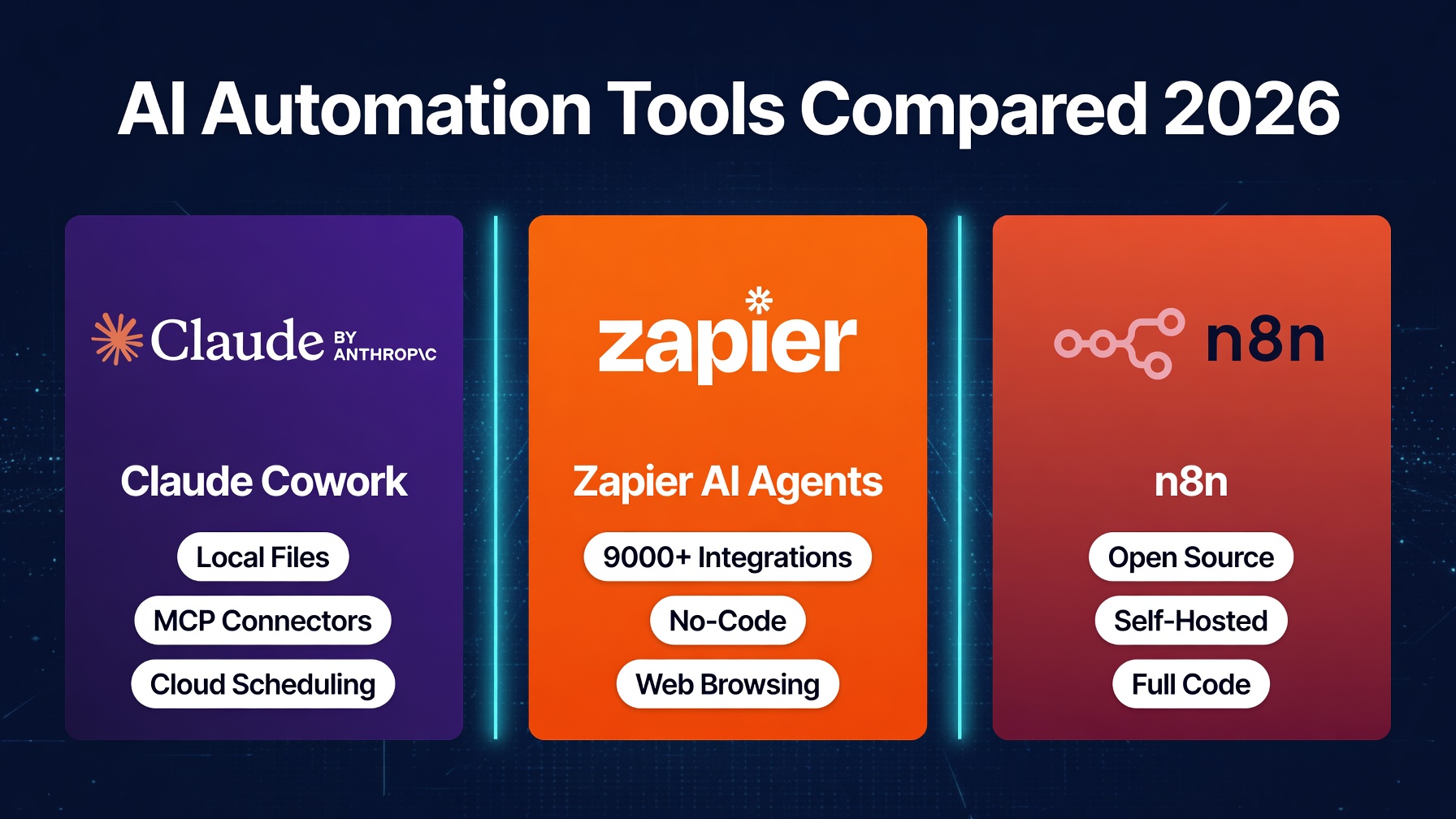
When people search Claude Cowork vs Zapier vs n8n, they are usually asking one practical question: should AI be the thing that runs my work, or a step inside a workflow I design? Zapier is the default for no-code operations teams, n8n is the pick for developers who want full control, and Claude (which now includes everything Cowork did) is where people go when they want to describe a task in plain English and let the AI work out the steps. Choosing the wrong one is an expensive mistake, because a Zap, an n8n graph and a conversational instruction do not port to each other.
One big change since we first published this comparison: on September 16, 2026, Anthropic merged Claude Cowork and chat into one Claude, rolling out to Pro and Max first, with Team and Free plans following and the unified experience generally available for Claude Enterprise on October 23. For this comparison, that means you no longer pick a separate Cowork app; Cowork capabilities, connectors, skills and scheduled tasks are available from any Claude conversation. The comparison below is about Claude (formerly Cowork) as a whole.
Updated October 2026: what changed
- Cowork is now part of Claude (September 16, 2026). Claude decides what a task needs; you no longer route work to a separate Cowork mode. Existing Cowork chats, projects, artifacts, connectors and skills carry over.
- Rollout: Pro and Max first, Team and Free soon, and general availability for Claude Enterprise on October 23, 2026. Anthropic stated no pricing changes.
- Claude can keep working on a task after you close your laptop, and scheduled tasks are supported.
- New: Claude Duet, a proactive agent in research preview (announced October 21, 2026, US Pro and Max waitlist).
- Zapier and n8n details re-checked against their own pricing and AI pages as of October 2026; older figures we could not confirm were removed.
Why This Comparison Matters Now
AI automation has split into two camps. The first, represented by Zapier, treats AI as a layer on top of existing integration pipelines. You still build Zaps (trigger plus actions) the way you always did, but AI fields, AI steps and separate Zapier Agents can now draft, classify and decide inside or alongside those flows. The second camp treats the AI as the primary runtime. n8n sits between the two: a code-friendly workflow graph with AI agent nodes you place inside it. Claude sits firmly in the second camp: you describe the outcome, and Claude picks the files, connectors and steps.
This architectural difference matters in practice. A Zapier user is building a flowchart with some AI steps in it. An n8n developer is building a workflow graph that can contain real code. A Claude user is giving natural-language instructions to an AI that decides at runtime what to read, which connector to call and what to write back. These are not the same thing, and they are not suited to the same problems.
What the Cowork merge changes
Before September 2026, comparing Cowork with Zapier meant comparing a specific Anthropic product mode with an integration platform. Now the comparison is with Claude itself. Anthropic’s announcement says you no longer choose where a task goes: Claude works out what the task needs, and Cowork and Design capabilities are available from any conversation using your existing context, skills and connectors. Practically, that lowers the barrier: anyone on a supported plan can schedule a weekly report without learning a separate app.
What Each Tool Is
Claude (formerly Cowork)
Claude is Anthropic’s AI assistant, available in the Claude app on web, desktop and mobile. Since the merge, the agentic work that used to live in Cowork, such as multi-step tasks across files, connectors and skills, happens in ordinary Claude conversations. Claude can keep working on a task after you close your laptop, can run scheduled tasks, and produces outputs such as Claude Docs, Claude Slides (beta on paid plans, downloadable as PowerPoint or PDF) and Claude Design work, each at a shareable link you can open on a phone.
Connectors and skills extend Claude’s reach beyond the conversation. Connectors are commonly built on the Model Context Protocol (see our MCP guide), and Anthropic cites more than 6,000 connectors and plugins in the Claude Marketplace. By default Claude asks before it takes an action; you can let it keep working and check in only when needed. In Anthropic’s words, you keep the final say.
What it is not: a traditional workflow automation tool. You do not build visual pipelines or conditional branch nodes. Claude makes those decisions at runtime based on your instruction. If you need deterministic, auditable workflows with branching logic visible in a UI, Claude on its own is the wrong choice.
Zapier
Zapier is the largest no-code automation platform, and as of October 2026 it says it connects to 9,000+ apps. A Zap is a trigger (something happens in App A) connected to one or more actions in other apps. Its AI lineup now includes AI steps and AI fields inside Zaps, Zapier Agents for building AI assistants, Chatbots, Copilot for building automations, Canvas for mapping workflows, and Zapier MCP, which lets an AI chat client such as Claude call Zapier actions.
Zapier’s strength is breadth and accessibility. It handles authentication and field mapping for you, so non-technical users can ship multi-app flows in an afternoon. In a Zap, the workflow orchestrates the AI, not the other way round, which gives you flowchart predictability with AI at specific decision points. The trade-offs are task-based pricing that grows with volume and a cloud-only runtime, so your data passes through Zapier’s infrastructure.
n8n
n8n is a fair-code workflow automation tool developers like because it gives them control. It can be self-hosted (the Community edition is on GitHub) or used as n8n Cloud. Its node editor is more complex than Zapier’s but more powerful: you can write JavaScript or Python inside nodes, call any REST API with the HTTP Request node, and build loops, sub-workflows and error-handling paths. AI agent nodes let you plug in models from OpenAI, Anthropic and others, while the workflow handles retries and logging.
Self-hosting is n8n’s defining feature for compliance-sensitive teams: you control the infrastructure and the data. The weakness is the learning curve. Non-trivial workflows need comfort with JSON, APIs and some programming. Teams without a technical lead will struggle to get value quickly.
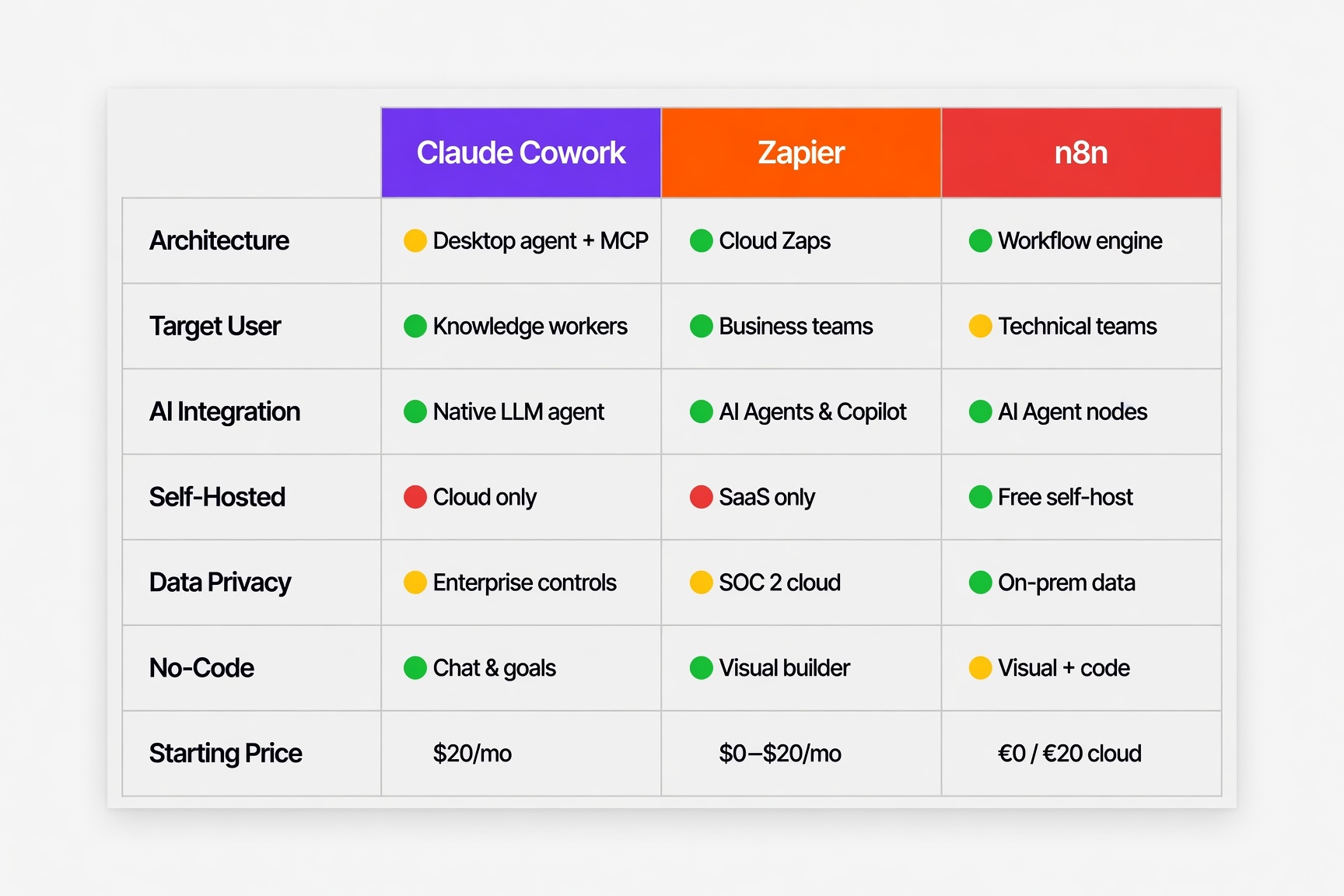
Claude Cowork vs Zapier vs n8n: Side-by-Side Technical Comparison
The table below reflects Claude after the Cowork merge and Zapier and n8n as described on their own sites as of October 2026. Plans and limits change often, so treat prices as a starting point and confirm on each vendor’s pricing page before you budget.
| Dimension | Claude (formerly Cowork) | Zapier | n8n |
|---|---|---|---|
| Architecture | AI-native, conversational; Claude plans the steps | Trigger and action flows with AI steps; separate Agents product | Node graph with code and AI agent nodes |
| Primary user | Knowledge workers, operators, small teams | Non-technical business users and ops teams | Developers and technical ops |
| Self-hosted option | No | No | Yes (Community edition) |
| Where it runs | Claude app on web, desktop and mobile; can keep working after you close your laptop | Zapier cloud | Your servers or n8n Cloud |
| Integrations | Connectors, skills and plugins; Anthropic cites 6,000+ in the Claude Marketplace | 9,000+ apps | Built-in nodes plus HTTP Request for any REST API |
| AI model | Claude | Zapier-managed AI; Zapier MCP also lets Claude call Zapier actions | Your choice of provider via AI nodes |
| Workflow visibility | Conversation and task history | Visual Zap editor and run history | Visual node editor and execution log |
| Scheduling | Scheduled tasks (for example a weekly report) | Schedule and app triggers | Cron and event triggers |
| Human approval | Asks before acting by default | Whatever the Zap is built to do | Whatever the workflow is built to do |
| Pricing model | Included in paid Claude plans; no change stated with the merge | Free tier; Professional from 19.99 USD per month, metered by tasks (as of October 2026) | Cloud plans metered by executions; self-hosted Community edition |
The single most useful row is the last one. Zapier counts each successful action as a task. n8n counts an execution as one full run of a workflow, regardless of how many steps it has. Claude’s cost is your subscription and its usage limits, so a long, complex task consumes more of your allowance rather than generating a per-step bill.
Developer Workflows: Where Each Tool Wins
Where Claude wins
Claude is strongest when the work involves reading and transforming documents, writing original content, or research-and-compile tasks where the output format is flexible. Content production is the clearest example: give Claude a folder of interview notes or research files and ask for themes and a draft in your brand voice, and it handles the whole job in one conversation, with the result as a Claude Doc or Slides deck you can share by link.
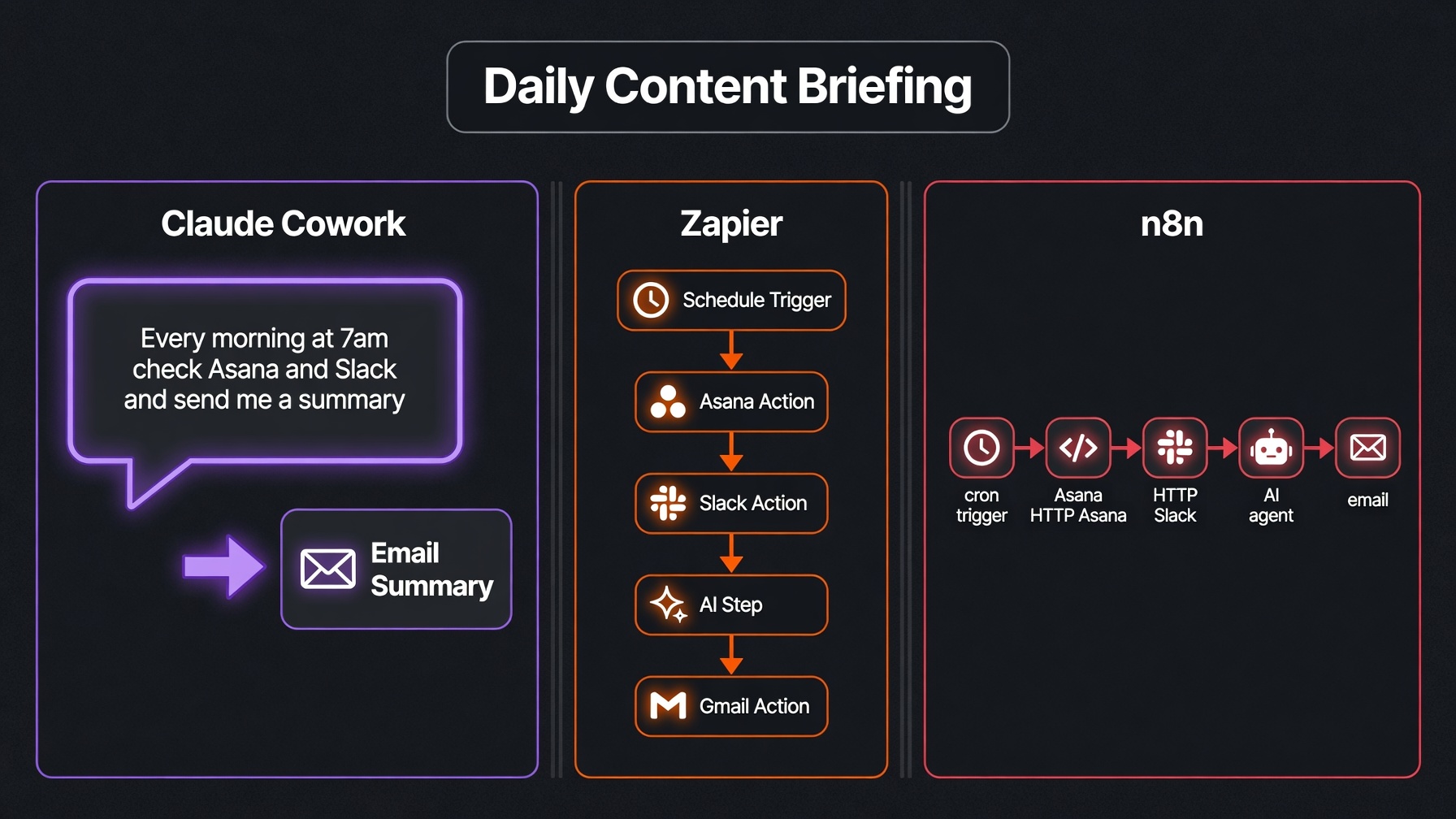
Scheduled briefings and digests are the other sweet spot. With connectors and scheduled tasks, Claude can produce a weekly status report every Monday from the tools you already connected, and because it can keep working after you close your laptop, you do not need to babysit it. If you want Claude to act inside team chat rather than in its own app, our Claude Tag guide covers how @Claude works in Slack.
Where Zapier wins
Zapier wins when you need breadth of integrations, predictable business-critical flows and a UI non-technical people can maintain. CRM and sales automation (lead routing, deal stage triggers, enrichment), form-to-workflow routing, and eCommerce chains such as new order to Slack alert to project task to customer email are its home ground. Claude cannot replace a CRM pipeline that must fire identically every time.
Where n8n wins
n8n wins when data control is non-negotiable, when the workflow needs real code, or when per-action pricing would break the economics. Self-hosted n8n runs in your own VPC or on-premise, so data only leaves when a workflow calls an external service. It handles loops over large datasets, split-in-batches, wait steps and nested sub-workflows, which matters if you need to call an API for every row of a 10,000-row CSV with retries and logging. Any REST API, including your internal ones, works through the HTTP Request node.
Can Claude Code replace Zapier and n8n?
Mostly no, and that is fine. Claude Code is Anthropic’s coding agent. It is excellent at writing the glue, such as a webhook handler, a custom n8n node or an MCP server. But the code still needs somewhere to run on a trigger, with retries, credentials and logs. A common developer pattern is Claude Code to build, n8n or your own infrastructure to run, and Claude for the judgment-heavy steps.
Claude Duet and Proactive Agents: Where They Fit
On October 21, 2026, Anthropic announced Claude Duet, a new app in which Claude works as a proactive agent. It is a research preview, available by waitlist starting with US Pro and Max subscribers, and it is currently separate from the main Claude app (on iOS, Android and claude.ai). It moves Claude closer to always-on automation, the territory Zapier and n8n have owned.
What Duet does
Duet sends a short morning brief of the most important items across your connected apps, monitors those apps during the day, and messages you only when something needs attention. It can take on tasks from scheduling meetings to building dashboards and forecasts, and it runs on its own cloud virtual machine with its own browser, so your laptop does not need to be on. It checks connected accounts every few hours rather than continuously, to conserve usage limits, and it is included in Pro and Max with the same limits.
Why it does not replace a Zap
Duet is judgment-driven, not event-driven. A Zap or n8n workflow fires the moment a webhook arrives and does the same thing every time. Duet checks periodically, decides what matters, and before sending a message, making a payment, signing a document or deleting anything, it shows you the action and waits for approval. Some actions, such as moving money between accounts or trading securities, are off-limits even with approval. Anthropic notes it may misread a thread or misjudge urgency. That makes Duet a strong personal operations assistant for professionals and small business owners, and a poor fit for a lead-routing pipeline that must run in seconds. For more on how always-on agents compare, see our Claude Dispatch vs OpenClaw breakdown.
Security, Privacy, and Compliance
Every AI automation tool processes your data somewhere, and where that happens varies significantly.
Claude
Claude is a hosted service, and work that continues after you close your laptop runs on Anthropic’s infrastructure, as does Duet’s virtual machine. The control model is approval-based: Claude asks before acting by default, and Duet shows destination, content and every recipient before sending anything. Anthropic says Duet never sees your passwords, cookies or sign-in tokens. For data use, retention and training terms, read Anthropic’s current policies for your plan; for regulated data, ask your compliance advisor before connecting systems.
Zapier
All Zap runs execute on Zapier’s cloud, so data from every connected app passes through its infrastructure. Zapier publishes security and compliance documentation and offers enterprise access controls; check its current certifications against your requirements. If workflows touch customer PII, financial records or health data, have your compliance advisor confirm the setup is acceptable for your industry and jurisdiction.
n8n
Self-hosted n8n gives you the most control in this group: nothing leaves your infrastructure unless a workflow explicitly calls an external API, including an AI model API. That last part matters. An n8n workflow that sends records to a hosted LLM still moves data off your servers, so the model provider’s terms apply too. n8n Cloud is a hosted service with a posture similar to other SaaS tools. For true data sovereignty, self-hosted n8n with a carefully chosen model provider is the only option here.
Claude Cowork vs Zapier vs n8n: Pricing at Scale
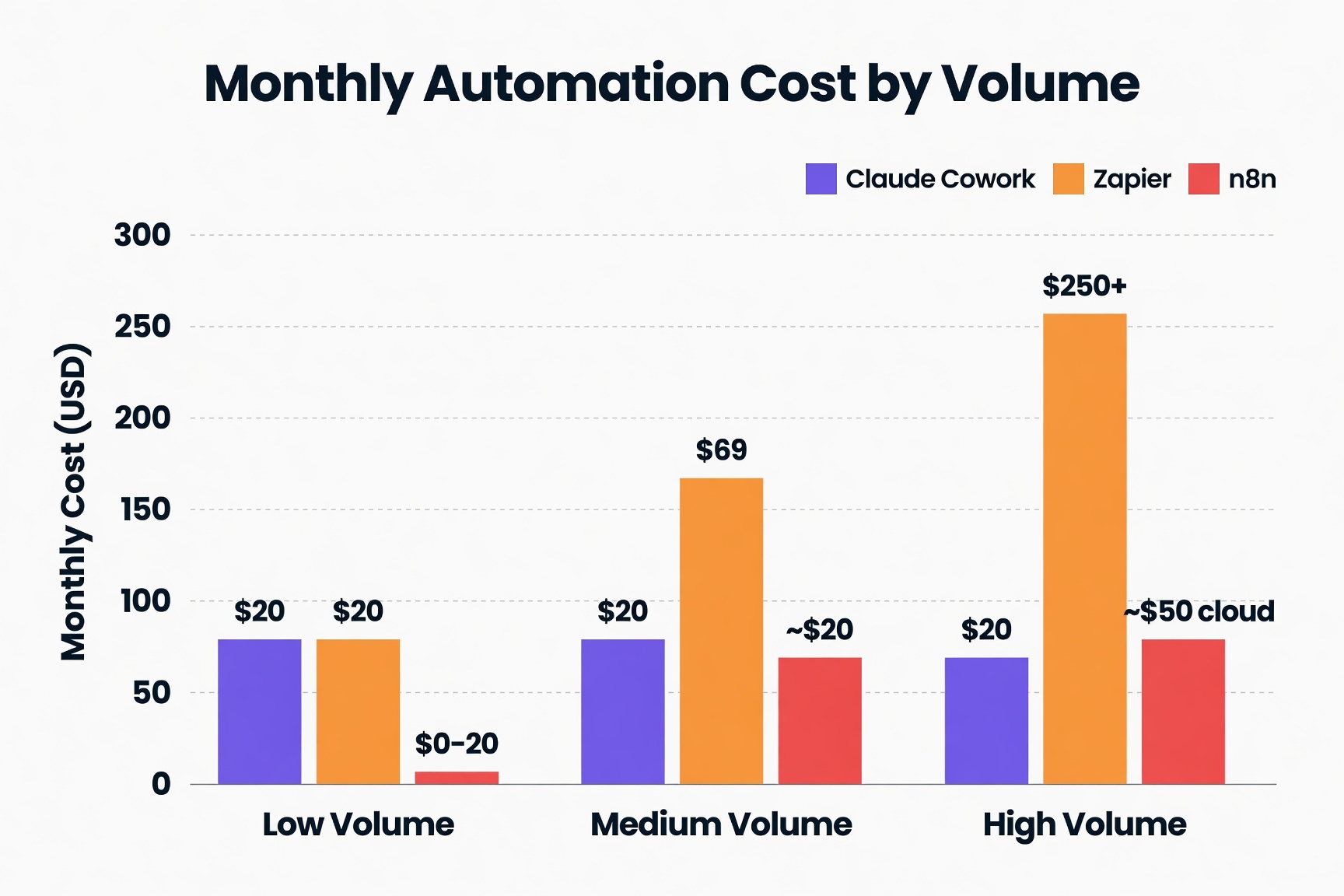
Pricing is where the three tools diverge most sharply, because each one meters something different. Here is how each model behaves as volume grows, with figures confirmed as of October 2026.
Claude: subscription and usage limits
Cowork capabilities are part of paid Claude plans, and Anthropic stated no pricing changes with the merge. There is no per-task or per-workflow charge; what you consume is your plan’s usage allowance, and bigger tasks use more of it. Duet shares the same Pro and Max limits, and its background checks count toward them. That suits moderate, judgment-heavy work better than thousands of identical runs a day. Check Anthropic’s pricing page for current plan prices.
Zapier: tasks per action
As of October 2026, Zapier has a Free plan with 100 tasks per month, Professional from 19.99 USD per month and Team from 69 USD per month, with task tiers that scale up to very high volumes and Enterprise on contract. A task is used each time an action succeeds; triggers, polling and built-in tools like Filter, Formatter and Paths are not charged. Zap steps, AI steps, code and MCP share one task pool, and one Zapier MCP tool call uses two tasks. Zapier Agents and Chatbots have their own plans. Model your volume before committing.
n8n: executions or infrastructure
n8n Cloud plans are metered by executions; as of October 2026 its pricing page lists 2,500 executions on Starter and 10,000 on Pro, with Business and Enterprise above that. A ten-step run is still one execution. Self-hosting the Community edition shifts the cost to your servers and the engineering time to maintain them, which is often the cheapest route at high volume if you already run infrastructure.
Community, Ecosystem, and Longevity
No automation tool is useful if its ecosystem stalls. Zapier is the most mature of the three, founded in 2011 and deeply embedded in no-code operations, with a 9,000+ app library that is hard to replicate. Its risk is price creep, not disappearance.
n8n has strong community momentum: an active forum, a large self-hosted user base and a fair-code license that keeps the source available. The risk is drift between what the cloud product offers and what self-hosters get, so read the plan comparison before relying on a feature.
Claude’s ecosystem has grown fast. When we first wrote this post, Cowork had a modest set of official plugins; Anthropic now cites 6,000+ connectors and plugins in the Claude Marketplace, and MCP has become a common standard for connecting AI to tools. The merge also signals that Cowork is now core to Claude, not a side product. If you need an obscure enterprise system, though, check that a connector exists before you plan around it. Zapier is still the safest bet for long-tail integrations, and Zapier MCP lets Claude borrow that reach.
Pros and Cons of Each Tool
Claude (formerly Cowork)
- Pros: no flow building; strong at documents, research and writing; outputs as shareable Docs, Slides and Designs; scheduled tasks; keeps working after you close your laptop; asks before acting.
- Cons: not deterministic; no visual workflow definition for a team to audit; no self-hosting; heavy volume runs into plan usage limits; rollout to Team and Free still in progress.
Zapier
- Pros: 9,000+ apps; easiest for non-technical teams; predictable, visible flows; AI steps, Agents and MCP options.
- Cons: per-action task pricing grows with volume; cloud-only; limited for complex code and large data loops.
n8n
- Pros: self-hosting and data control; real code in nodes; per-execution rather than per-step metering; any model provider.
- Cons: steeper learning curve; self-hosting means DevOps work; fewer turnkey integrations than Zapier.
Frequently Asked Questions
Is Claude Cowork still available?
Yes, but not as a separate product. On September 16, 2026, Anthropic merged Claude Cowork and chat into one Claude. Cowork capabilities are now available from any Claude conversation, and Claude decides what a task needs instead of you choosing a mode. Your existing Cowork chats, projects, artifacts, connectors and skills are preserved, and there is nothing to turn on. The rollout started with Pro and Max in the Claude app on web, desktop and mobile, with Team and Free plans to follow, and the unified experience became generally available for Claude Enterprise on October 23, 2026. Read ‘Cowork’ as ‘Claude’ throughout this comparison.
Can I use Claude with Zapier or n8n together?
Yes, and for teams with mixed needs this is often the right answer. Claude handles document-heavy, research-heavy and writing-heavy work; Zapier or n8n handles structured data routing and multi-app pipelines that must run the same way every time. Zapier MCP lets Claude call Zapier actions directly, giving Claude access to Zapier’s app library (each MCP tool call uses two Zapier tasks, as of October 2026). Alternatively, n8n can ingest, transform and route business data, then call Claude through an AI node or drop briefing files where a Claude scheduled task picks them up.
Is Claude suitable for teams or just individuals?
Both, with caveats. The unified Claude is rolling out to Team plans after Pro and Max, and it is generally available on Enterprise, where admins get at least 30 days notice of changes and choose when to enable Docs and Slides. What Claude still lacks is a single, visual definition of ‘what automation is running’ that any team member can inspect and edit. Each person’s conversations and scheduled tasks are their own. If your team needs a shared source of truth for automation logic, Zapier’s or n8n’s workflow editors are the better fit, with Claude used for the work that needs judgment.
Does n8n require a developer to maintain?
For self-hosted n8n, yes. You need someone comfortable with server administration, updates, backups, credentials and JSON configuration. n8n Cloud removes the server work, so you can focus on building workflows, but it still asks for more technical comfort than Zapier. If your team has no technical members, start with Zapier, or with Claude for document-centric work. If you have one developer who can spend a few hours a week on automation, n8n Cloud is very manageable, and self-hosting becomes reasonable once volume or data-control requirements justify it.
Which tool handles the most complex AI tasks?
It depends on what ‘complex’ means. For conversational, context-heavy work, such as writing a report from many sources, analyzing a set of documents or researching a topic end to end, Claude is strongest because the model plans the work itself with your context, skills and connectors. For AI as one step in a larger business process, such as classifying an email or summarizing a record before routing it, Zapier’s AI steps or n8n’s AI agent nodes are a better fit because the surrounding workflow guarantees what happens next. If you need to swap model providers or run a custom model in the same workflow, n8n gives you the most flexibility. For a broader view of agent trade-offs, see our guide to the pros and cons of AI agents for business.
The Bottom Line
Choosing between Claude, Zapier and n8n is not about which tool is best; it is about matching the tool to the work. Choose Claude (formerly Cowork) if your work is document-centric, research-intensive or content-driven and you want AI to be the primary actor rather than a step inside a flowchart. If you already pay for a Claude plan, the merge means those capabilities are simply there, with no separate app to adopt. Keep an eye on Claude Duet if you want a proactive assistant that watches your apps, but treat it as a research preview.
Choose Zapier if your team is non-technical, you need many SaaS apps connected quickly, and reliability and breadth matter more than cost control or data location. Choose n8n if you have a developer, data control is non-negotiable, or volume makes per-action pricing unworkable. In practice, many stacks use two of the three: a workflow tool for the deterministic plumbing and Claude for the steps that need judgment.
Building an AI automation stack or an AI feature into your product? Talk to Lycore – we help technical and non-technical teams design automation that actually ships.