
Automated Trading Bots and Tools
Execution algorithms, strategy automation, crypto exchange bots and backtesting infrastructure for trading firms, with limits, kill switches and audit trails built into the order path from day one.
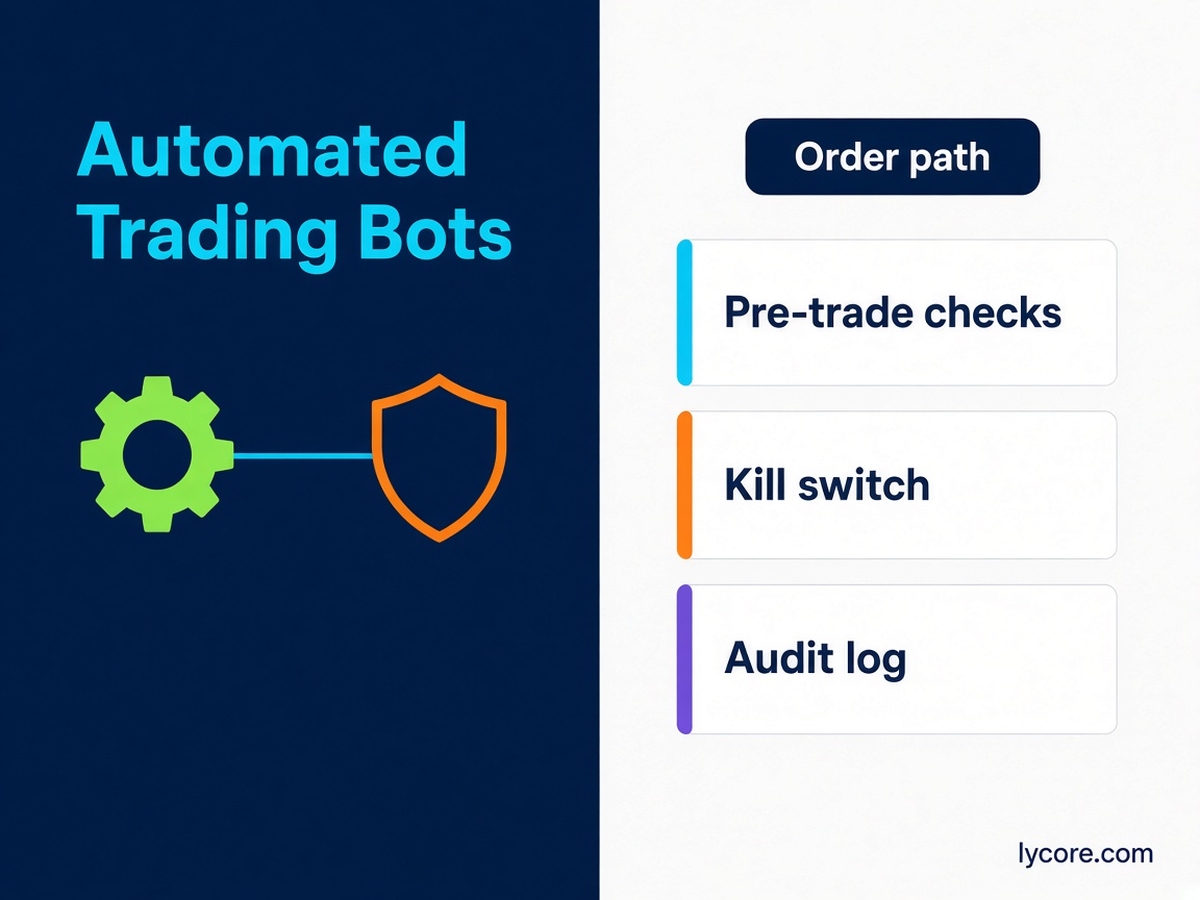
What are automated trading bots?
Automated trading bots are programs that turn a defined strategy or execution instruction into orders without manual entry: they read market data, apply rules or models, size and route orders, and manage open positions. Automation makes execution faster and more consistent. It also makes mistakes faster, so the controls matter as much as the strategy logic.
A strategy that loses a little per day by hand can lose far more at machine speed if nothing is watching. That is why we treat risk management as the foundation of an automated system, not a feature added once it works. Limits, kill switches and reconciliation are in the first release.
We build automated trading systems for firms that own their strategies, from simple rules-based execution tools to multi-strategy platforms, as part of our AI development services. The strategy and the risk appetite are yours; we build the machinery that runs them safely.
Automated trading systems we build
From a single execution tool to a full platform, each piece connects to your data, venues and order management.
Algorithmic execution
VWAP, TWAP and implementation shortfall algorithms that split large orders into child orders, take size, side, instrument, urgency and constraints as inputs, and report progress back to your order management system.
Strategy automation platforms
Signal ingestion, position sizing within configured risk parameters, order generation and routing, position monitoring, and automated stops, limit enforcement and drawdown-triggered de-risking.
Crypto trading bots
Around-the-clock operation with rate-limit handling, retries and failover, multi-exchange connectivity through CCXT, and Redis position state reconciled against each exchange.
Backtesting and simulation
Point-in-time data, out-of-sample periods, slippage and impact models based on liquidity, and Monte Carlo stress tests, running the same strategy code as live trading.
Paper trading and replay
Strategies run against live or recorded market data without sending real orders, so behavior can be checked before any capital is committed.
Monitoring and operator tools
Dashboards for P&L, positions and orders, alerts as limits approach, and AI summaries of logs and incidents for operators.
Risk and control infrastructure
Every automated system we build includes the same control layers. They sit in the order path, so no order reaches a venue without passing them.
- Pre-trade risk checks. Position, notional, order size and price collar limits enforced before an order leaves the system.
- Loss limits. Intraday and cumulative P&L limits that trigger automated de-risking or a full halt.
- Kill switch. Authorized users can cancel open orders and block new ones, with immediate effect.
- State persistence and reconciliation. Positions and orders are stored and reconciled with the broker or exchange after any restart or connection loss.
- Anomaly detection. Alerts on unusual position concentration, order rates or P&L attribution.
- Audit trail. Every order, fill, cancel, limit change and override is recorded for post-trade analysis and your record-keeping.
Typical stack
- Connectivity: CCXT for crypto, FIX, REST and WebSocket for other venues.
- Real-time state: Redis for positions and risk state.
- Strategy logic: Python with NumPy vectorization.
- Storage: PostgreSQL for orders and audit, time-series storage for market data.
- Infrastructure: AWS regions chosen for proximity to your venues.
- Monitoring: Dashboards and paging alerts on limit approach.
Oversight and compliance
Automation changes how fast things happen, not who is responsible. These rules apply to every trading system we deliver.
- Your strategy, your decisions. We implement the logic your team specifies. Which strategies run, and with how much capital, is decided by your people.
- Staged rollout. New strategies move from backtest to paper trading to small size before full deployment, with a recorded sign-off at each step.
- Venue rules respected. Order-rate throttles and message limits keep systems within each venue’s rules.
- AI kept out of the order decision by default. Language models summarize logs and incidents. They do not decide orders unless your firm designs, validates and approves such a model.
- Records for your regulators. Retention and reporting follow the requirements your compliance team and counsel define.
We make no performance claims for any system we build. Automated trading supports execution; results depend on the strategy and the market.
An order engine you can try in LyTrade
LyTrade, one of our working apps, is the software a proprietary trading firm runs on. All trading in it is simulated with sandbox payments, but its server-side engine shows how we build order handling and automated rule enforcement.
LyTrade
Trading: software a prop firm runs on, with simulated trading
Traders place orders in a simulated account, and the engine is the single source of truth for fills, P&L and rules. The app only sends requests and shows results.
- Order types. Market, limit and stop orders with stop loss and take profit, partial close, close and close all.
- Simulated costs. Spread and commission are simulated per instrument, and margin uses each instrument’s leverage.
- Rules on every tick. Rules are checked on each price tick and fill. A hard-rule breach closes all positions, cancels pending orders and fails the account.
- Server-side and restart-safe. Enforcement runs whether or not the trader has the app open, and positions and day-start balances are stored so nothing is lost on a restart.
- Live feed or replay. Operators switch between a live feed and labeled market replay without code changes.
The same engine patterns carry over to client systems that place real orders, with the venue adapters and controls described above.
Related reading
Technical guides from our blog on trading bots and execution systems.
Crypto trading bot development: complete technical guide
AI-powered trading software and algorithmic bots
Algorithmic trading platforms: backtesting and live execution
Rule-based trading alerts: custom app build guide
How to build a trading platform: essential features
Real-time compliance risk dashboard: build guide
More trading guides: AI stock research, AI signal generation and AI capital management. Back to the AI for trading overview, see every AI for industries guide, or read how we build and price this work on our AI development services page.
Frequently asked questions
Can you build a bot that trades profitably on its own?
We cannot promise that, and you should be wary of anyone who does. We build the software that runs your strategy reliably: data handling, order generation, execution, position tracking and risk controls. Whether a strategy makes money depends on the strategy and the market, not on the code that executes it. We make no performance or return claims, and decisions about which strategies to run and with how much capital stay with your team.
Which exchanges and brokers can you connect to?
Crypto exchanges through the CCXT library or their native REST and WebSocket APIs, and brokers or venues that offer FIX, REST or WebSocket access for equities, futures and FX. The right choice depends on what your broker supports and your latency needs. Each venue has its own rate limits, order types and failure modes, so we build an adapter per venue with retries, reconnection and reconciliation, and test it against the venue’s sandbox before live use.
How do you stop an automated trading bot from running away?
With layered controls. Pre-trade checks block orders that breach position, notional, size or price limits before they leave the system. Intraday and cumulative loss limits trigger de-risking or a halt. Order-rate throttles catch loops. A kill switch lets authorized staff cancel open orders and stop new ones immediately. State is stored and reconciled with the venue on restart, and a halted strategy restarts only when a person decides it should.
How long does it take to build an automated trading system?
We work at USD 25 per hour offshore, on a fixed project price or on a monthly retainer. As an indicative guide, a single execution tool or exchange bot with risk controls usually falls in the USD 7K-15K band, a strategy automation platform with backtesting in the USD 15K-30K band, and a multi-venue platform with execution algorithms, monitoring and audit in the USD 30K-50K band or above USD 50K. Market data, exchange and AI model usage fees are paid to those providers, and we estimate them before the build starts. Timelines depend on venue count and controls.
Building automated trading bots or tools?
Tell us about your strategy type, venues and controls. We will tell you how we would build it, what it would cost and how long it would take.
Talk to Lycore